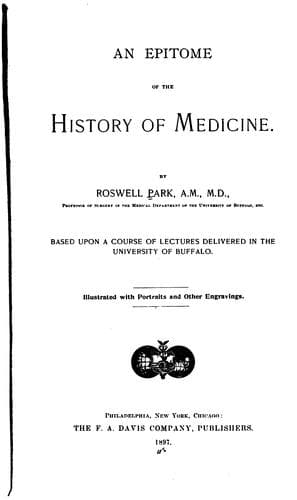
An Epitome of the History of MedicinePark, Roswell
History
An Epitome of the History of Medicine
Park, Roswell
Medicine -- History
A study of the general history of the Arabic Period reveals that the
Arabs, previously obscure and uncivilized, emerged rapidly from the
demi-savage state, and took the first rank among the polished nations of
the world. During the earliest portion of this period these people were
religious vandals and destructive fanatics, but later embraced with
enthusiasm and persistence a study of the humanities, and endeavored to
repair their early ravages by collecting the _débris_ of the literary
and scientific monuments of Greece; but, though they cultivated medicine
with zeal and success, they added little to the Greek treasures. Later,
Arabia was overrun by hordes from the deserts of Tartary, a people yet
more barbarous and unknown, who established themselves in all parts of
the globe then under Saracenic dominion, and by their brutal despotism
degraded the Arabians to a condition approaching that from which
they had emerged. This seems to have been ever the result of Turkish
conquest.
Meanwhile the Greek nation, which was for so many ages at the head of
civilization, gradually lost its power, virtue, courage, glory, and
independence, and continued to descend, until now it exercises no
influence whatever on the course of events. During the course of the
Arabic Period only one Grecian physician merits mention on account of
his writings, and in these there was nothing-new except what he had
borrowed without credit from the Saracens.
The Empire of the West,--that is the western part of the ancient Roman
Empire,--after subjugation by barbarians from Germany and Scandinavia,
fell under a cloud whose darkness overwhelmed it. Its people, however,
gradually received new life by commingling their blood with that of the
invaders. Later they were able to repulse the Saracens{098} who poured
in upon them from Spain; then they turned their armies against each
other, and wrought mutual havoc and ruin for several centuries. Again,
roused by religious fanaticism, as had been the Mohammedans previously,
they rushed by thousands upon the plains of Asia Minor, Syria, and
Egypt, which had been for centuries occupied by the Arabs; and their
adventures and enterprises, and the new and varied scenes through which
they passed, gave rise among the "Francs" to some taste for poetry
and works of imagination During the twelfth and thirteenth centuries
governments became more stable, liberal institutions were created, the
rust of ignorance gradually disappeared, and by the end of the Arabic
Period there were really apparent brilliant streaks of mentality in the
horizon of the nations of Europe. In this progressive movement the
study of medicine shared. In the thirteenth century it was worthily
represented in Italy, in Paris, and became established in Montpellier.
Notwithstanding, up to this time physicians apparently only knew how to
timidly follow in the track of the Arabians, and approached little, or
not at all, in their studies, the purer lore of the Greeks.
Public-domain text, read in full here on John Shaqi.
Reviews
Reviews
No reviews yet
Be the first to share your thoughts on this work.
Elsewhere in the archive
Join the Discussion
Join the discussion
Sign in to leave a comment or review.
Sign InorCreate an account