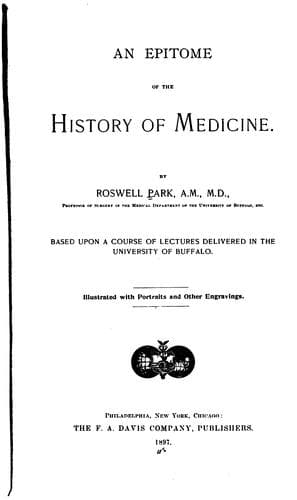
An Epitome of the History of MedicinePark, Roswell
History
An Epitome of the History of Medicine
Park, Roswell
Medicine -- History
contented himself with comparing the motion of the blood with the flux
and reflux of Euripus, as Aristotle had done. It is even thus that
he tortured his mind in trying to reconcile two irreconcilable
theories,--i.e., the opinion of the ancients on the motion of the blood
and recent discoveries in the anatomy of the vascular system.
CHAPTER V.
_Age of Renovation (continued).--Erudite Period (continued): Benivieni,
11502. Jean Fern el, 1497-1553. Porta, 1536-1615. Severino, 1580-1656.
Incorporation of Brotherhood of St. Come into the University of Paris,
1515. Ambroise Paré, 1510-1590. Guillemeau, 1550-1613. Influence of the
Occult Sciences: Agrippa, 1486-1535. Jerome Cardan, f 1501. Paracelsus,
14931541. Botal, born 1530. Joubert, 1529-1583._
In the{114} domain of pathology the Arabs had added only a very small
number of observations to those contained in the works of Galen. The
most interesting of these pertain to eruptive fevers. Most of
their writers contented themselves with making an inventory of the
acquisitions of the past, as did Guy de Chauliac, and this was about all
they could do under existing circumstances; although they did not make
discoveries, they prepared the way for their successors.
Two men about this time did a great deal in the direction of creating
a desire for post-mortem study of cases, and in illustrating and
succinctly describing symptoms.
The first of these was Benivieni, a Florentine, who died in 1502--the
date of his birth being uncertain. To him, more than to any other, we
owe the commencement of the study of gross pathology and pathological
anatomy. He was the first to consider the knowledge that might be
obtained by opening bodies for the sole purpose of ascertaining
the location and cause of the diseases from which they had died. As
Malgaigne remarks: "A eulogy which he merits, and which he shared with
no other person, and which has not been accorded to him up to this time
by the many historians of surgery who have superficially searched among
these precious sources, is that he was the first who had the habit,
felt the need, and set the useful example, which he transmitted to his
successors, of searching in the cadaver, according to the title of his
book, for the concealed causes of disease." The work referred to by
Malgaigne was{115} entitled: _Concerning Some of the Secret and Strange
Causes of Disease_ and was published in Florence in 1507. It is poor in
quotations, but rich in original observations, which pertain especially
to the etiology of disease, and gives a very concise symptomatology and
history of each affection of which it treats, as well as a pathological
explanation. Benivieni's observations on gall-stone, on the anatomical
lesions of heart diseases, and on the conveyance of syphilis from
the mother to the foetus were original, as well as many observations
concerning the presence of worms and other parasites in the body.
Public-domain text, read in full here on John Shaqi.
Reviews
Reviews
No reviews yet
Be the first to share your thoughts on this work.
Elsewhere in the archive
Join the Discussion
Join the discussion
Sign in to leave a comment or review.
Sign InorCreate an account