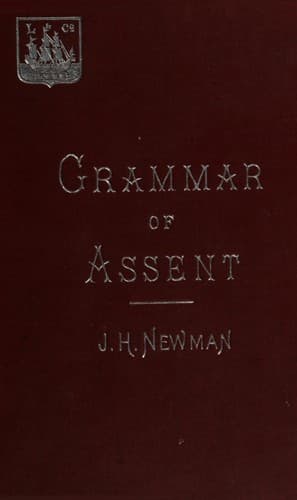
An Essay in Aid of a Grammar of AssentNewman, John Henry
Religion
An Essay in Aid of a Grammar of Assent
Newman, John Henry
Faith; Theism
I have been showing that inference and assent are distinct acts of the
mind, and that they may be made apart from each other. Of course I
cannot be taken to mean that there is no legitimate or actual connexion
between them, as if arguments adverse to a conclusion did not naturally
hinder assent; or as if the inclination to give assent were not greater
or less according as the particular act of inference expressed a
stronger or weaker probability; or as if assent did not always imply
grounds in reason, implicit, if not explicit, or could be rightly given
without sufficient grounds. So much is it commonly felt that assent
must be preceded by inferential acts, that obstinate men give their own
will as their very reason for assenting, if they can think of nothing
better; “stat pro ratione voluntas.” Indeed, I doubt whether assent is
ever given without some preliminary, which stands for a reason; but it
does not follow from this, that it may not be withheld in cases when
there are good reasons for giving it to a proposition, or may not be
withdrawn after it has been given, the reasons remaining, or may not
remain when the reasons are forgotten; or must always vary in strength,
as the reasons vary; and this substantiveness, as I may call it, of the
act of assent is the very point which I have wished to establish.
2. And in showing that assent is distinct from an act of inference, I
have gone a good way towards showing in what it differs from it. If
assent and inference are each of them the acceptance of a proposition,
but the special characteristic of inference is that it is conditional,
it is natural to suppose that assent is unconditional. Again, if
assent is the acceptance of truth, and truth is the proper object of
the intellect, and no one can hold conditionally what by the same
act he holds to be true, here too is a reason for saying that assent
is an adhesion without reserve or doubt to the proposition to which
it is given. And again, it is to be presumed that the word has not
two meanings: what it has at one time, it has at another. Inference
is always inference; even if demonstrative, it is still conditional;
it establishes an incontrovertible conclusion on the condition of
incontrovertible premisses. To the conclusion thus drawn, assent gives
its absolute recognition. In the case of all demonstrations, assent,
when given, is unconditionally given. In one class of subjects, then,
assent certainly is always unconditional; but if the word stands for
an undoubting and unhesitating act of the mind once, why does it not
denote the same always? what evidence is there that it ever means any
thing else than that which the whole world will unite in witnessing
that it means in certain cases? why are we not to interpret what is
controverted by what is known? This is what is suggested on the first
view of the question; but to continue:—
Public-domain text, read in full here on John Shaqi.
Reviews
Reviews
No reviews yet
Be the first to share your thoughts on this work.
Elsewhere in the archive
Join the Discussion
Join the discussion
Sign in to leave a comment or review.
Sign InorCreate an account