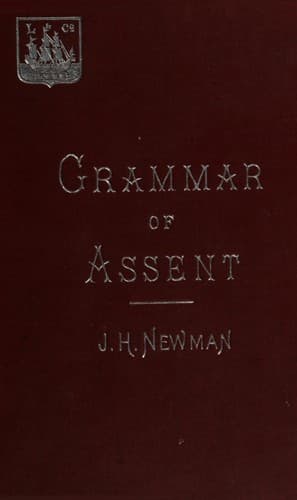
An Essay in Aid of a Grammar of AssentNewman, John Henry
Religion
An Essay in Aid of a Grammar of Assent
Newman, John Henry
Faith; Theism
We laugh to scorn the idea that we had no parents, though we have no
memory of our birth; that we shall never depart this life, though we
can have no experience of the future; that we are able to live without
food, though we have never tried; that a world of men did not live
before our time, or that that world has had no history; that there has
been no rise and fall of states, no great men, no wars, no revolutions,
no art, no science, no literature, no religion.
We should be either indignant or amused at the report of our intimate
friend being false to us; and we are able sometimes, without any
hesitation, to accuse certain parties of hostility and injustice to us.
We may have a deep consciousness, which we never can lose, that we on
our part have been cruel to others, and that they have felt us to be
so, or that we have been, and have been felt to be, ungenerous to those
who love us. We may have an overpowering sense of our moral weakness,
of the precariousness of our life, health, wealth, position, and good
fortune. We may have a clear view of the weak points of our physical
constitution, of what food or medicine is good for us, and what does
us harm. We may be able to master, at least in part, the course of our
past history; its turning-points, our hits, and our great mistakes. We
may have a sense of the presence of a Supreme Being, which never has
been dimmed by even a passing shadow, which has inhabited us ever since
we can recollect any thing, and which we cannot imagine our losing. We
may be able, for others have been able, so to realize the precepts and
truths of Christianity, as deliberately to surrender our life, rather
than transgress the one or to deny the other.
On all these truths we have an immediate and an unhesitating hold,
nor do we think ourselves guilty of not loving truth for truth’s
sake, because we cannot reach them through a series of intuitive
propositions. Assent on reasonings not demonstrative is too widely
recognized an act to be irrational, unless man’s nature is irrational,
too familiar to the prudent and clear-minded to be an infirmity or
an extravagance. None of us can think or act without the acceptance
of truths, not intuitive, not demonstrated, yet sovereign. If our
nature has any constitution, any laws, one of them is this absolute
reception of propositions as true, which lie outside the narrow range
of conclusions to which logic, formal or virtual, is tethered; nor has
any philosophical theory the power to force on us a rule which will not
work for a day.
Public-domain text, read in full here on John Shaqi.
Reviews
Reviews
No reviews yet
Be the first to share your thoughts on this work.
Elsewhere in the archive
Join the Discussion
Join the discussion
Sign in to leave a comment or review.
Sign InorCreate an account