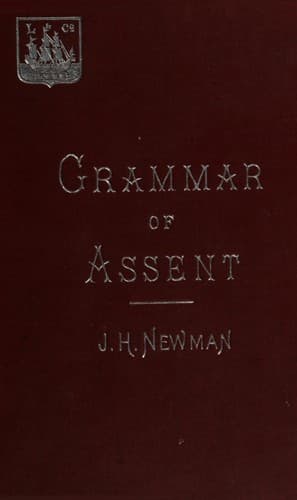
An Essay in Aid of a Grammar of AssentNewman, John Henry
Religion
An Essay in Aid of a Grammar of Assent
Newman, John Henry
Faith; Theism
We do not dispense with clocks, because from time to time they go
wrong, and tell untruly. A clock, organically considered, may be
perfect, yet it may require regulating. Till that needful work is
done, the moment-hand may mark the half-minute, when the minute-hand
is at the quarter-past, and the hour hand is just at noon, and the
quarter-bell strikes the three-quarters, and the hour-bell strikes
four, while the sun-dial precisely tells two o’clock. The sense of
certitude may be called the bell of the intellect; and that it strikes
when it should not is a proof that the clock is out of order, no proof
that the bell will be untrustworthy and useless, when it comes to us
adjusted and regulated from the hands of the clock-maker.
Our conscience too may be said to strike the hours, and will strike
them wrongly, unless it be duly regulated for the performance of its
proper function. It is the loud announcement of the principle of right
in the details of conduct, as the sense of certitude is the clear
witness to what is true. Both certitude and conscience have a place in
the normal condition of the mind. As a human being, I am unable, if
I were to try, to live without some kind of conscience; and I am as
little able to live without those landmarks of thought which certitude
secures for me; still, as the hammer of a clock may tell untruly, so
may my conscience and my sense of certitude be attached to mental
acts, whether of consent or of assent, which have no claim to be thus
sanctioned. Both the moral and the intellectual sanction are liable to
be biassed by personal inclinations and motives; both require and admit
of discipline; and, as it is no disproof of the authority of conscience
that false consciences abound, neither does it destroy the importance
and the uses of certitude, because even educated minds, who are earnest
in their inquiries after the truth, in many cases remain under the
power of prejudice or delusion.
To this deficiency in mental training a wider error is to be
attributed,—the mistaking for conviction and certitude states and
frames of mind which make no pretence to the fundamental condition on
which conviction rests as distinct from assent. The multitude of men
confuse together the probable, the possible, and the certain, and apply
these terms to doctrines and statements almost at random. They have no
clear view what it is they know, what they presume, what they suppose,
and what they only assert. They make little distinction between
credence, opinion, and profession; at various times they give them all
perhaps the name of certitude, and accordingly, when they change their
minds, they fancy they have given up points of which they had a true
conviction. Or at least bystanders thus speak of them, and the very
idea of certitude falls into disrepute.
Public-domain text, read in full here on John Shaqi.
Reviews
Reviews
No reviews yet
Be the first to share your thoughts on this work.
Elsewhere in the archive
Join the Discussion
Join the discussion
Sign in to leave a comment or review.
Sign InorCreate an account