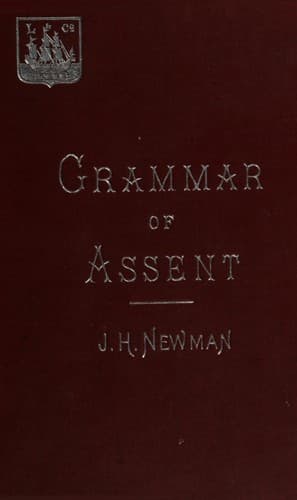
An Essay in Aid of a Grammar of AssentNewman, John Henry
Religion
An Essay in Aid of a Grammar of Assent
Newman, John Henry
Faith; Theism
Each thing has its own nature and its own history. When the nature and
the history of many things are similar, we say that they have the same
nature; but there is no such thing as one and the same nature; they are
each of them itself, not identical, but like. A law is not a fact, but
a notion. “All men die; therefore Elias has died;” but he has not died,
and did not die. He was an exception to the general law of humanity;
so far, he did not come under that law, but under the law (so to say)
of Elias. It was the peculiarity of his individuality, that he left
the world without dying: what right have we to subject the person of
Elias to the scientific notion of an abstract humanity, which we have
formed without asking his leave? Why must the tyrant majority find a
rule for his history? “But all men are mortal;” not so; what is really
meant is, that “man, as such, is mortal,” or the abstract, typical
_auto-anthropos_; therefore the minor premiss ought to be, “Elias was
the _auto-anthropos_ or abstract man;” but he was not, and could not be
the abstract man, nor could any one else, any more than the average man
of an Insurance Company is every individual man who insures his life
with it. Such a syllogism proves nothing about the veritable Elias,
except in the way of antecedent probability. If it be said that Elias
was exempted from death, not by nature, but by miracle, what is this
to the purpose, undeniable as it is? Still, to have this miraculous
exemption was the personal prerogative of Elias. We call it miracle,
because God ordinarily acts otherwise. He who causes men in general
to die, gave to Elias not to die. This miraculous gift comes into the
individuality of Elias. On this individuality we must fix our thoughts,
and not begin our notion of him by ignoring it. He was a man, and
something more than “man”; and if we do not take this into account, we
fall into an initial error in our thoughts of him.
Public-domain text, read in full here on John Shaqi.
Reviews
Reviews
No reviews yet
Be the first to share your thoughts on this work.
Elsewhere in the archive
Join the Discussion
Join the discussion
Sign in to leave a comment or review.
Sign InorCreate an account