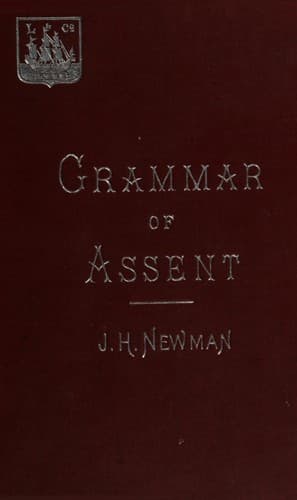
An Essay in Aid of a Grammar of AssentNewman, John Henry
Religion
An Essay in Aid of a Grammar of Assent
Newman, John Henry
Faith; Theism
it is obligatory to profess any religion in particular; what are the
standards of truth and falsehood in religion; and what are the special
claims of the Church.
And so, again, as to the minor premiss, perhaps he will answer, that
he is not a Protestant; that he is a Catholic of the early undivided
Church; that he is a Catholic, but not a Papist. Then he has to
determine questions about division, schism, visible unity, what is
essential, what is desirable; about provisional states; as to the
adjustment of the Church’s claims with those of personal judgment and
responsibility; as to the soul of the Church contrasted with the body;
as to degrees of proof, and the degree necessary for his conversion;
as to what is called his providential position, and the responsibility
of change; as to the sincerity of his purpose to follow the Divine
Will, whithersoever it may lead him; as to his intellectual capacity of
investigating such questions at all.
None of these questions, as they come before him, admit of simple
demonstration; but each carries with it a number of independent
probable arguments, sufficient, when united, for a reasonable
conclusion about itself. And first he determines that the questions are
such as he personally, with such talents or attainments as he has, may
fairly entertain; and then he goes on, after deliberation, to form a
definite judgment upon them; and determines them, one way or another,
in their bearing on the bald syllogism which was originally offered
to his acceptance. And, we will say, he comes to the conclusion, that
he ought to accept it as true in his case; that he is a Protestant
in such a sense, of such a complexion, of such knowledge, under such
circumstances, as to be called upon by duty to join the Church; that
this is a conclusion of which he can be certain, and ought to be
certain, and that he will be incurring grave responsibility, if he
does not accept it as certain, and act upon the certainty of it. And
to this conclusion he comes, as is plain, not by any possible verbal
enumeration of all the considerations, minute but abundant, delicate
but effective, which unite to bring him to it; but by a mental
comprehension of the whole case, and a discernment of its upshot,
sometimes after much deliberation, but, it may be, by a clear and rapid
act of the intellect, always, however, by an unwritten summing-up,
something like the summation of the terms, _plus_ and _minus_ of an
algebraical series.
This I conceive to be the real method of reasoning in concrete matters;
and it has these characteristics:—First, it does not supersede the
logical form of inference, but is one and the same with it; only it is
no longer an abstraction, but carried out into the realities of life,
its premisses being instinct with the substance and the momentum of
that mass of probabilities, which, acting upon each other in correction
and confirmation, carry it home definitely to the individual case,
which is its original scope.
Public-domain text, read in full here on John Shaqi.
Reviews
Reviews
No reviews yet
Be the first to share your thoughts on this work.
Elsewhere in the archive
Join the Discussion
Join the discussion
Sign in to leave a comment or review.
Sign InorCreate an account