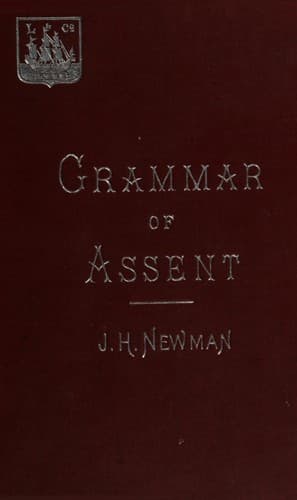
An Essay in Aid of a Grammar of AssentNewman, John Henry
Religion
An Essay in Aid of a Grammar of Assent
Newman, John Henry
Faith; Theism
It is true that the human frame, in all instances which come before
me, first grows, and then declines, wastes, and decays, in visible
preparation for dissolution. We see death seldom, but of this decline
we are witnesses daily; still, it is a plain fact, that most men who
die, die, not by any law of death, but by the law of disease; and some
writers have questioned whether death is ever, strictly speaking,
natural. Now, are diseases necessary? is there any law that every one,
sooner or later, must fall under the power of disease? and what would
happen on a large scale, were there no diseases? Is what we call the
law of death anything more than the chance of disease? Is the prospect
of my death, in its logical evidence,—as that evidence is brought home
to me—much more than a high probability?
The strongest proof I have for my inevitable mortality is the _reductio
ad absurdum_. Can I point to the man, in historic times, who has
lived his two hundred years? What has become of past generations of
men, unless it is true that they suffered dissolution? But this is
a circuitous argument to warrant a conclusion to which in matter
of fact I adhere so relentlessly. Anyhow, there is a considerable
“surplusage,” as Locke calls it, of belief over proof, when I determine
that I individually must die. But what logic cannot do, my own living
personal reasoning, my good sense, which is the healthy condition of
such personal reasoning, but which cannot adequately express itself in
words, does for me, and I am possessed with the most precise, absolute,
masterful certitude of my dying some day or other.
I am led on by these reflections to make another remark. If it is
difficult to explain how a man knows that he shall die, is it not more
difficult for him to satisfy himself how he knows that he was born?
His knowledge about himself does not rest on memory, nor on distinct
testimony, nor on circumstantial evidence. Can he bring into one
focus of proof the reasons which make him so sure? I am not speaking
of scientific men, who have diverse channels of knowledge, but of an
ordinary individual, as one of ourselves.
Answers doubtless may be given to some of these questions; but, on the
whole, I think it is the fact that many of our most obstinate and most
reasonable certitudes depend on proofs which are informal and personal,
which baffle our powers of analysis, and cannot be brought under
logical rule, because they cannot be submitted to logical statistics.
If we must speak of Law, this recognition of a correlation between
certitude and implicit proof seems to me a law of our minds.
2.
Public-domain text, read in full here on John Shaqi.
Reviews
Reviews
No reviews yet
Be the first to share your thoughts on this work.
Elsewhere in the archive
Join the Discussion
Join the discussion
Sign in to leave a comment or review.
Sign InorCreate an account