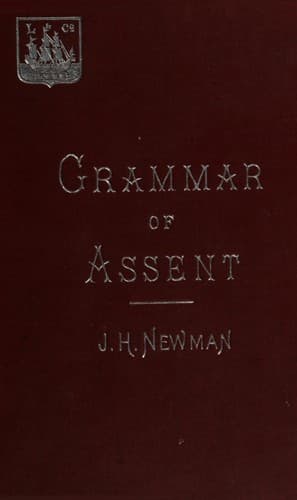
An Essay in Aid of a Grammar of AssentNewman, John Henry
Religion
An Essay in Aid of a Grammar of Assent
Newman, John Henry
Faith; Theism
A peasant who is weather-wise may be simply unable to assign
intelligible reasons why he thinks it will be fine to-morrow; and if
he attempts to do so, he may give reasons wide of the mark; but that
will not weaken his own confidence in his prediction. His mind does not
proceed step by step, but he feels all at once the force of various
combined phenomena, though he is not conscious of them. Again, there
are physicians who excel in the _diagnosis_ of complaints; though it
does not follow from this, that they could defend their decision in a
particular case against a brother physician who disputed it. They are
guided by natural acuteness and varied experience; they have their own
idiosyncratic modes of observing, generalizing, and concluding; when
questioned, they can but rest on their own authority, or appeal to
the future event. In a popular novel,(25) a lawyer is introduced, who
“would know, almost by instinct, whether an accused person was or was
not guilty; and he had already perceived by instinct” that the heroine
was guilty. “I’ve no doubt she’s a clever woman,” he said, and at once
named an attorney practising at the Old Bailey. So, again, experts and
detectives, when employed to investigate mysteries, in cases whether
of the civil or criminal law, discern and follow out indications which
promise solution with a sagacity incomprehensible to ordinary men.
A parallel gift is the intuitive perception of character possessed
by certain men, while others are as destitute of it, as others again
are of an ear for music. What common measure is there between the
judgments of those who have this intuition, and those who have not?
What but the event can settle any difference of opinion which occurs in
their estimation of a third person? These are instances of a natural
capacity, or of nature improved by practice and habit, enabling the
mind to pass promptly from one set of facts to another, not only, I
say, without conscious media, but without conscious antecedents.
Sometimes, I say, this illative faculty is nothing short of genius.
Such seems to have been Newton’s perception of truths mathematical and
physical, though proof was absent. At least that is the impression left
on my own mind by various stories which are told of him, one of which
was stated in the public papers a few years ago. “Professor Sylvester,”
it was said, “has just discovered the proof of Sir Isaac Newton’s rule
for ascertaining the imaginary roots of equations.... This rule has
been a Gordian-knot among algebraists for the last century and a half.
The proof being wanting, authors became ashamed at length of advancing
a proposition, the evidence for which rested on no other foundation
than belief in Newton’s sagacity.(26)”
Public-domain text, read in full here on John Shaqi.
Reviews
Reviews
No reviews yet
Be the first to share your thoughts on this work.
Elsewhere in the archive
Join the Discussion
Join the discussion
Sign in to leave a comment or review.
Sign InorCreate an account