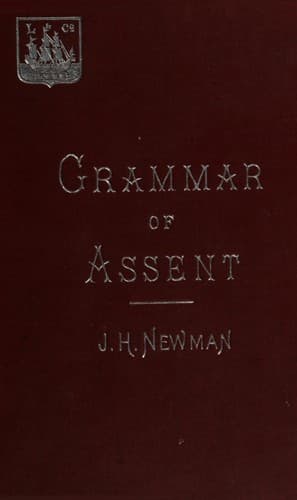
An Essay in Aid of a Grammar of AssentNewman, John Henry
Religion
An Essay in Aid of a Grammar of Assent
Newman, John Henry
Faith; Theism
I am not contrasting these various opinions of able men, who have given
themselves to historical research, as if it were any reflection on them
that they differ from each other. It is the cause of their differing
on which I wish to insist. Taking the facts by themselves, probably
these authors would come to no conclusion at all; it is the “tacit
understandings” which Mr. Grote speaks of, the vague and impalpable
notions of “reasonableness” on his own side as well as on that of
others, which both make conclusions possible, and are the pledge of
their being contradictory. The conclusions vary with the particular
writer, for each writes from his own point of view and with his own
principles, and these admit of no common measure.
This in fact is their own account of the matter: “The results of
speculative historical inquiry,” says Colonel Mure, “can rarely
amount to more than fair presumption of the reality of the events in
question, as limited to their general substance, not as extending to
their details. Nor can there consequently be expected in the minds
of different inquirers any such unity regarding the precise degree
of reality, as may frequently exist in respect to events attested by
documentary evidence.” Mr. Grote corroborates this decision by the
striking instance of the diversity of existing opinions concerning the
Homeric Poems. “Our means of knowledge,” he says, “are so limited,
that no one can produce arguments sufficiently cogent to contend
against opposing preconceptions, and it creates a painful sensation
of diffidence, when we read the expressions of equal and absolute
persuasion with which the two opposite conclusions have both been
advanced.” And again, “There is a difference of opinion among the
best critics, which is probably not destined to be adjusted, since so
much depends partly upon critical feeling, partly upon the general
reasonings in respect to ancient epical unity, with which a man sits
down to the study.” Exactly so; every one has his own “critical
feeling,” his antecedent “reasonings,” and in consequence his own
“absolute persuasion,” coming in fresh and fresh at every turn of the
discussion; and who, whether stranger or friend, is to reach and affect
what is so intimately bound up with the mental constitution of each?
Public-domain text, read in full here on John Shaqi.
Reviews
Reviews
No reviews yet
Be the first to share your thoughts on this work.
Elsewhere in the archive
Join the Discussion
Join the discussion
Sign in to leave a comment or review.
Sign InorCreate an account