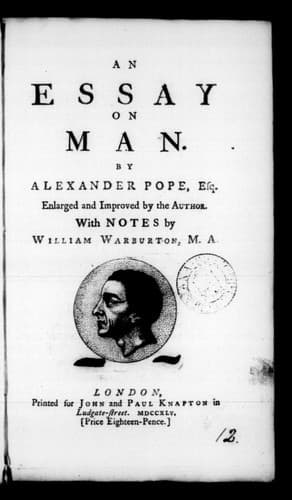
An Essay on Man; Moral Essays and SatiresPope, Alexander
ReligionComparative
An Essay on Man; Moral Essays and Satires
Pope, Alexander
English poetry -- 18th century
And teach the being you preserved, to bear.
But why then publish? Granville the polite,
And knowing Walsh, would tell me I could write;
Well-natured Garth, inflamed with early praise;
And Congreve loved, and Swift endured my lays;
The courtly Talbot, Somers, Sheffield, read;
Even mitred Rochester would nod the head,
And St. John's self (great Dryden's friends before)
With open arms received one poet more.
Happy my studies, when by these approved!
Happier their author, when by these beloved!
From these the world will judge of men and books,
Not from the Burnets, Oldmixons, and Cookes.
Soft were my numbers; who could take offence,
While pure description held the place of sense?
Like gentle Fanny's was my flowery theme,
A painted mistress, or a purling stream.
Yet then did Gildon draw his venal quill;--
I wished the man a dinner, and sat still.
Yet then did Dennis rave in furious fret;
I never answered--I was not in debt.
If want provoked, or madness made them print,
I waged no war with Bedlam or the Mint.
Did some more sober critic come abroad;
If wrong, I smiled; if right, I kissed the rod.
Pains, reading, study, are their just pretence,
And all they want is spirit, taste, and sense.
Commas and points they set exactly right,
And 'twere a sin to rob them of their mite.
Yet ne'er one sprig of laurel graced these ribalds,
From slashing Bentley down to p---g Tibalds:
Each wight, who reads not, and but scans and spells,
Each word-catcher, that lives on syllables,
Even such small critics some regard may claim,
Preserved in Milton's or in Shakespeare's name.
Pretty! in amber to observe the forms
Of hairs, or straws, or dirt, or grubs, or worms!
The things, we know, are neither rich nor rare,
But wonder how the devil they got there.
Were others angry: I excused them too;
Well might they rage, I gave them but their due.
A man's true merit 'tis not hard to find;
But each man's secret standard in his mind,
That casting-weight pride adds to emptiness,
This, who can gratify? for who can guess?
The bard whom pilfered pastorals renown,
Who turns a Persian tale for half a crown,
Just writes to make his barrenness appear,
And strains, from hard-bound brains, eight lines a year;
He, who still wanting, though he lives on theft,
Steals much, spends little, yet has nothing left:
And he, who now to sense, now nonsense leaning,
Means not, but blunders round about a meaning:
And he, whose fustian's so sublimely bad,
It is not poetry, but prose run mad:
All these, my modest satire bade translate,
And owned that nine such poets made a Tate.
How did they fume, and stamp, and roar, and chafe
And swear not Addison himself was safe.
Peace to all such! but were there one whose fires
True genius kindles, and fair fame inspires;
Blessed with each talent and each art to please,
And born to write, converse, and live with ease:
Should such a man, too fond to rule alone,
Bear, like the Turk, no brother near the throne.
View him with scornful, yet with jealous eyes,
Public-domain text, read in full here on John Shaqi.
Reviews
Reviews
No reviews yet
Be the first to share your thoughts on this work.
Elsewhere in the archive
Join the Discussion
Join the discussion
Sign in to leave a comment or review.
Sign InorCreate an account