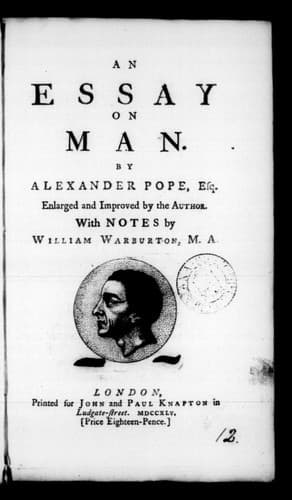
An Essay on Man; Moral Essays and SatiresPope, Alexander
ReligionComparative
An Essay on Man; Moral Essays and Satires
Pope, Alexander
English poetry -- 18th century
In dirt and darkness, hundreds stink content.
Of all these ways, if each pursues his own,
Satire be kind, and let the wretch alone:
But show me one who has it in his power
To act consistent with himself an hour.
Sir Job sailed forth, the evening bright and still,
"No place on earth," he cried, "like Greenwich Hill!"
Up starts a palace; lo, th' obedient base }
Slopes at its foot, the woods its sides embrace, }
The silver Thames reflects its marble face. }
Now let some whimsy, or that devil within }
Which guides all those who know not what they mean, }
But give the knight (or give his lady) spleen; }
"Away, away! take all your scaffolds down,
For snug's the word: my dear! we'll live in town."
At amorous Flavio is the stocking thrown?
That very night he longs to lie alone.
The fool, whose wife elopes some thrice a quarter,
For matrimonial solace dies a martyr.
Did ever Proteus, Merlin, any witch, }
Transform themselves so strangely as the rich? }
Well, but the poor--the poor have the same itch; }
They change their weekly barber, weekly news,
Prefer a new japanner to their shoes,
Discharge their garrets, move their beds, and run
(They know not whither) in a chaise and one;
They hire their sculler, and when once aboard,
Grow sick, and damn the climate--like a lord.
You laugh, half beau, half sloven if I stand,
My wig all powder, and all snuff my band;
You laugh, if coat and breeches strangely vary,
White gloves, and linen worthy Lady Mary!
But when no prelate's lawn with hair-shirt lined,
Is half so incoherent as my mind,
When (each opinion with the next at strife,
One ebb and flow of follies all my life)
I plant, root up; I build, and then confound;
Turn round to square, and square again to round;
You never change one muscle of your face,
You think this madness but a common case,
Nor once to Chancery, nor to Hale apply;
Yet hang your lip, to see a seam awry!
Careless how ill I with myself agree,
Kind to my dress, my figure, not to me.
Is this my guide, philosopher, and Friend?
This, he who loves me, and who ought to mend?
Who ought to make me (what he can, or none),
That man divine whom wisdom calls her own;
Great without title, without fortune blessed;
Rich even when plundered, honoured while oppressed;
Loved without youth, and followed without power;
At home, though exiled; free, though in the Tower;
In short, that reasoning, high, immortal thing,
Just less than Jove, and much above a king,
Nay, half in heaven--except (what's mighty odd)
A fit of vapours clouds this demi-god.
THE SIXTH EPISTLE OF THE FIRST BOOK OF HORACE.
EPISTLE VI. TO MR. MURRAY.
Public-domain text, read in full here on John Shaqi.
Reviews
Reviews
No reviews yet
Be the first to share your thoughts on this work.
Elsewhere in the archive
Join the Discussion
Join the discussion
Sign in to leave a comment or review.
Sign InorCreate an account