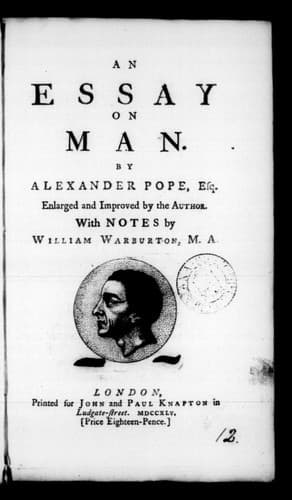
An Essay on Man; Moral Essays and SatiresPope, Alexander
ReligionComparative
An Essay on Man; Moral Essays and Satires
Pope, Alexander
English poetry -- 18th century
Was sheathed, and luxury with Charles restored;
In every taste of foreign courts improved,
"All, by the king's example, lived and loved."
Then peers grew proud in horsemanship t' excel,
Newmarket's glory rose, as Britain's fell;
The soldier breathed the gallantries of France,
And every flowery courtier wrote romance.
Then marble, softened into life, grew warm:
And yielding metal flowed to human form:
Lely on animated canvas stole
The sleepy eye, that spoke the melting soul.
No wonder then, when all was love and sport,
The willing Muses were debauched at court:
On each enervate string they taught the note
To pant, or tremble through an eunuch's throat.
But Britain, changeful as a child at play,
Now calls in princes, and now turns away.
Now Whig, now Tory, what we loved we hate;
Now all for pleasure, now for Church and State;
Now for prerogative, and now for laws;
Effects unhappy from a noble cause.
Time was, a sober Englishman would knock
His servants up, and rise by five o'clock,
Instruct his family in every rule,
And send his wife to church, his son to school.
To worship like his fathers, was his care;
To teach their frugal virtues to his heir;
To prove, that luxury could never hold;
And place, on good security, his gold.
Now times are changed, and one poetic itch
Has seized the court and city, poor and rich:
Sons, sires, and grandsires, all will wear the bays,
Our wives read Milton, and our daughters plays,
To theatres, and to rehearsals throng,
And all our grace at table is a song.
I, who so oft renounce the Muses, lie,
Not ----'s self e'er tells more fibs than I;
When sick of Muse, our follies we deplore,
And promise our best friends to rhyme no more;
We wake next morning in a raging fit,
And call for pen and ink to show our wit.
He served a 'prenticeship, who sets up shop;
Ward tried on puppies, and the poor, his drop;
Even Radcliff's doctors travel first to France,
Nor dare to practise till they've learned to dance.
Who builds a bridge that never drove a pile?
(Should Ripley venture, all the world would smile)
But those who cannot write, and those who can,
All rhyme, and scrawl, and scribble, to a man.
Yet, sir, reflect, the mischief is not great;
These madmen never hurt the Church or State;
Sometimes the folly benefits mankind;
And rarely av'rice taints the tuneful mind.
Allow him but his plaything of a pen,
He ne'er rebels, or plots, like other men:
Flight of cashiers, or mobs, he'll never mind;
And knows no losses while the Muse is kind.
To cheat a friend, or ward, he leaves to Peter;
The good man heaps up nothing but mere metre,
Enjoys his garden and his book in quiet;
And then--a perfect hermit in his diet.
Of little use the man you may suppose,
Who says in verse what others say in prose;
Yet let me show, a poet's of some weight,
And (though no soldier) useful to the State.
What will a child learn sooner than a song?
What better teach a foreigner the tongue?
What's long or short, each accent where to place,
Public-domain text, read in full here on John Shaqi.
Reviews
Reviews
No reviews yet
Be the first to share your thoughts on this work.
Elsewhere in the archive
Join the Discussion
Join the discussion
Sign in to leave a comment or review.
Sign InorCreate an account