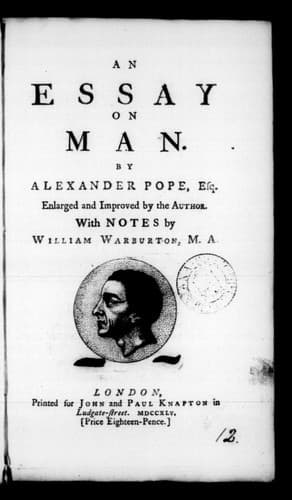
An Essay on Man; Moral Essays and SatiresPope, Alexander
ReligionComparative
An Essay on Man; Moral Essays and Satires
Pope, Alexander
English poetry -- 18th century
In all but this, a man of sober life,
Fond of his friend, and civil to his wife;
Not quite a madman, though a pasty fell,
And much too wise to walk into a well.
Him, the damned doctors and his friends immured,
They bled, they cupped, they purged; in short, they cured.
Whereat the gentleman began to stare--
"My friends!" he cried, "plague take you for your care!
That from a patriot of distinguished note,
Have bled and purged me to a simple vote."
Well, on the whole, plain prose must be my fate:
Wisdom (curse on it) will come soon or late.
There is a time when poets will grow dull:
I'll e'en leave verses to the boys at school:
To rules of poetry no more confined,
I learn to smooth and harmonise my mind,
Teach every thought within its bounds to roll,
And keep the equal measure of the soul.
Soon as I enter at my country door
My mind resumes the thread it dropt before;
Thoughts, which at Hyde Park Corner I forgot,
Meet and rejoin me, in the pensive grot.
There all alone, and compliments apart,
I ask these sober questions of my heart.
If, when the more you drink, the more you crave,
You tell the doctor; when the more you have,
The more you want; why not with equal ease
Confess as well your folly, as disease?
The heart resolves this matter in a thrice,
"Men only feel the smart but not the vice."
When golden angels cease to cure the evil,
You give all royal witchcraft to the devil;
When servile chaplains cry, that birth and place
Endure a peer with honour, truth, and grace,
Look in that breast, most dirty D----! be fair,
Say, can you find out one such lodger there?
Yet still, not heeding what your heart can teach,
You go to church to hear these flatterers preach.
Indeed, could wealth bestow or wit or merit,
A grain of courage, or a spark of spirit,
The wisest man might blush, I must agree,
If D*** loved sixpence more than he.
If there be truth in law, and use can give
A property, that's yours on which you life.
Delightful Abs Court, if its fields afford
Their fruits to you, confesses you its lord;
All Worldly's hens, nay partridge, sold to town:
His venison too, a guinea makes your own:
He bought at thousands, what with better wit
You purchase as you want, and bit by bit;
Now, or long since, what difference will be found?
You pay a penny, and he paid a pound.
Heathcote himself, and such large-acred men,
Lords of fat E'sham, or of Lincoln fen,
Buy every stick of wood that lends them heat,
Buy every pullet they afford to eat.
Yet these are wights, who fondly call their own
Half that the Devil o'erlooks from Lincoln town.
The laws of God, as well as of the land,
Abhor, a perpetuity should stand:
Estates have wings and hang in fortune's power
Loose on the point of every wavering hour,
Ready, by force, or of your own accord,
By sale, at least by death, to change their lord.
Man? and for ever? wretch! what wouldst thou have?
Heir urges heir, like wave impelling wave.
All vast possessions (just the same the case
Public-domain text, read in full here on John Shaqi.
Reviews
Reviews
No reviews yet
Be the first to share your thoughts on this work.
Elsewhere in the archive
Join the Discussion
Join the discussion
Sign in to leave a comment or review.
Sign InorCreate an account