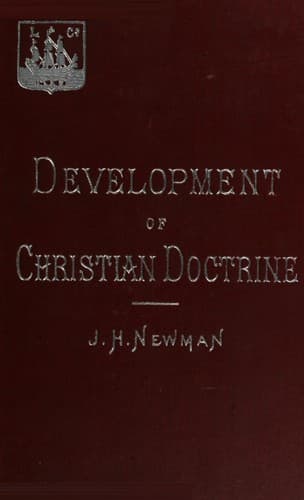
An Essay on the Development of Christian DoctrineNewman, John Henry
Religion
An Essay on the Development of Christian Doctrine
Newman, John Henry
Catholic Church -- Doctrines; Dogma, Development of
In the controversy carried on by various learned men in the seventeenth
and following century, concerning the statements of the early Fathers on
this subject, the one party determined the patristic theology by the
literal force of the separate expressions or phrases used in it, or by
the philosophical opinions of the day; the other, by the doctrine of the
Catholic Church, as afterwards authoritatively declared. The one party
argued that those Fathers _need not_ have meant more than what was
afterwards considered heresy; the other answered that there is _nothing
to prevent_ their meaning more. Thus the position which Bull maintains
seems to be nothing beyond this, that the Nicene Creed is a natural key
for interpreting the body of Ante-nicene theology. His very aim is to
explain difficulties; now the notion of difficulties and their
explanation implies a rule to which they are apparent exceptions, and in
accordance with which they are to be explained. Nay, the title of his
work, which is a "Defence of the Creed of Nicæa," shows that he is not
investigating what is true and what false, but explaining and justifying
a foregone conclusion, as sanctioned by the testimony of the great
Council. Unless the statements of the Fathers had suggested
difficulties, his work would have had no object. He allows that their
language is not such as they would have used after the Creed had been
imposed; but he says in effect that, if we will but take it in our hands
and apply it equitably to their writings, we shall bring out and
harmonize their teaching, clear their ambiguities, and discover their
anomalous statements to be few and insignificant. In other words, he
begins with a presumption, and shows how naturally facts close round it
and fall in with it, if we will but let them. He does this triumphantly,
yet he has an arduous work; out of about thirty writers whom he reviews,
he has, for one cause or other, to "explain piously" nearly twenty.
SECTION II.
OUR LORD'S INCARNATION AND THE DIGNITY OF HIS BLESSED MOTHER AND OF ALL
SAINTS.
Bishop Bull's controversy had regard to Ante-nicene writers only, and to
little more than to the doctrine of the Divine Son's consubstantiality
and co-eternity; and, as being controversy, it necessarily narrows and
dries up a large and fertile subject. Let us see whether, treated
historically, it will not present itself to us in various aspects which
may rightly be called developments, as coming into view, one out of
another, and following one after another by a natural order of
succession.
2.
Public-domain text, read in full here on John Shaqi.
Reviews
Reviews
No reviews yet
Be the first to share your thoughts on this work.
Elsewhere in the archive
Join the Discussion
Join the discussion
Sign in to leave a comment or review.
Sign InorCreate an account