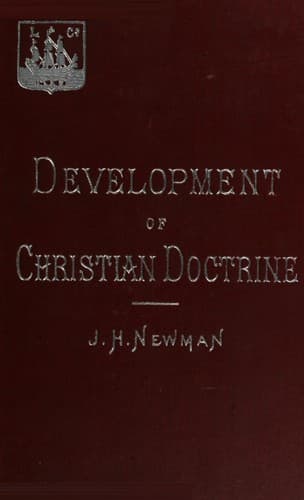
An Essay on the Development of Christian DoctrineNewman, John Henry
Religion
An Essay on the Development of Christian Doctrine
Newman, John Henry
Catholic Church -- Doctrines; Dogma, Development of
For instance, it is true, St. Ignatius is silent in his Epistles on the
subject of the Pope's authority; but if in fact that authority could not
be in active operation then, such silence is not so difficult to account
for as the silence of Seneca or Plutarch about Christianity itself, or
of Lucian about the Roman people. St. Ignatius directed his doctrine
according to the need. While Apostles were on earth, there was the
display neither of Bishop nor Pope; their power had no prominence, as
being exercised by Apostles. In course of time, first the power of the
Bishop displayed itself, and then the power of the Pope. When the
Apostles were taken away, Christianity did not at once break into
portions; yet separate localities might begin to be the scene of
internal dissensions, and a local arbiter in consequence would be
wanted. Christians at home did not yet quarrel with Christians abroad;
they quarrelled at home among themselves. St. Ignatius applied the
fitting remedy. The _Sacramentum Unitatis_ was acknowledged on all
hands; the mode of fulfilling and the means of securing it would vary
with the occasion; and the determination of its essence, its seat, and
its laws would be a gradual supply for a gradual necessity.
3.
This is but natural, and is parallel to instances which happen daily,
and may be so considered without prejudice to the divine right whether
of the Episcopate or of the Papacy. It is a common occurrence for a
quarrel and a lawsuit to bring out the state of the law, and then the
most unexpected results often follow. St. Peter's prerogative would
remain a mere letter, till the complication of ecclesiastical matters
became the cause of ascertaining it. While Christians were "of one heart
and one soul," it would be suspended; love dispenses with laws.
Christians knew that they must live in unity, and they were in unity; in
what that unity consisted, how far they could proceed, as it were, in
bending it, and what at length was the point at which it broke, was an
irrelevant as well as unwelcome inquiry. Relatives often live together
in happy ignorance of their respective rights and properties, till a
father or a husband dies; and then they find themselves against their
will in separate interests, and on divergent courses, and dare not move
without legal advisers. Again, the case is conceivable of a corporation
or an Academical body, going on for centuries in the performance of the
routine-business which came in its way, and preserving a good
understanding between its members, with statutes almost a dead letter
and no precedents to explain them, and the rights of its various classes
and functions undefined,--then of its being suddenly thrown back by the
force of circumstances upon the question of its formal character as a
body politic, and in consequence developing in the relation of governors
and governed. The _regalia Petri_ might sleep, as the power of a
Chancellor has slept; not as an obsolete, for they never had been
Public-domain text, read in full here on John Shaqi.
Reviews
Reviews
No reviews yet
Be the first to share your thoughts on this work.
Elsewhere in the archive
Join the Discussion
Join the discussion
Sign in to leave a comment or review.
Sign InorCreate an account