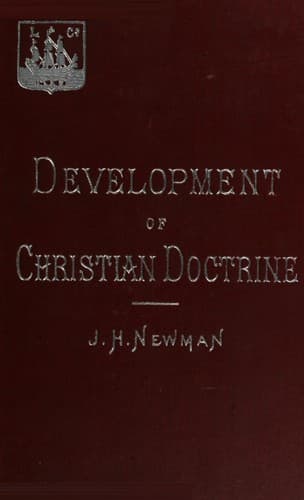
An Essay on the Development of Christian DoctrineNewman, John Henry
Religion
An Essay on the Development of Christian Doctrine
Newman, John Henry
Catholic Church -- Doctrines; Dogma, Development of
I have been engaged in drawing out the positive and direct argument in
proof of the intimate connexion, or rather oneness, with primitive
Apostolic teaching, of the body of doctrine known at this day by
the name of Catholic, and professed substantially both by Eastern
and Western Christendom. That faith is undeniably the historical
continuation of the religious system, which bore the name of Catholic in
the eighteenth century, in the seventeenth, in the sixteenth, and so
back in every preceding century, till we arrive at the first;--undeniably
the successor, the representative, the heir of the religion of Cyprian,
Basil, Ambrose and Augustine. The only question that can be raised is
whether the said Catholic faith, as now held, is logically, as well as
historically, the representative of the ancient faith. This then is the
subject, to which I have as yet addressed myself, and I have maintained
that modern Catholicism is nothing else but simply the legitimate growth
and complement, that is, the natural and necessary development, of the
doctrine of the early church, and that its divine authority is included
in the divinity of Christianity.
2.
So far I have gone, but an important objection presents itself for
distinct consideration. It may be said in answer to me that it is not
enough that a certain large system of doctrine, such as that which goes
by the name of Catholic, should admit of being referred to beliefs,
opinions, and usages which prevailed among the first Christians, in
order to my having a logical right to include a reception of the later
teaching in the reception of the earlier; that an intellectual
development may be in one sense natural, and yet untrue to its original,
as diseases come of nature, yet are the destruction, or rather the
negation of health; that the causes which stimulate the growth of ideas
may also disturb and deform them; and that Christianity might indeed
have been intended by its Divine Author for a wide expansion of the
ideas proper to it, and yet this great benefit hindered by the evil
birth of cognate errors which acted as its counterfeit; in a word, that
what I have called developments in the Roman Church are nothing more or
less than what used to be called her corruptions; and that new names do
not destroy old grievances.
This is what may be said, and I acknowledge its force: it becomes
necessary in consequence to assign certain characteristics of faithful
developments, which none but faithful developments have, and the
presence of which serves as a test to discriminate between them and
corruptions. This I at once proceed to do, and I shall begin by
determining what a corruption is, and why it cannot rightly be called,
and how it differs from, a development.
3.
Public-domain text, read in full here on John Shaqi.
Reviews
Reviews
No reviews yet
Be the first to share your thoughts on this work.
Elsewhere in the archive
Join the Discussion
Join the discussion
Sign in to leave a comment or review.
Sign InorCreate an account