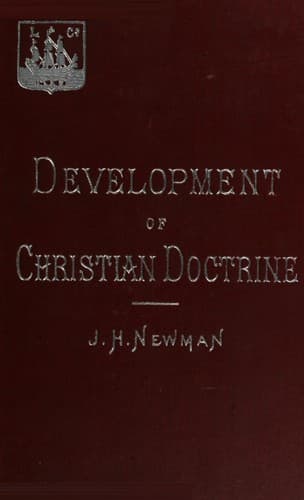
An Essay on the Development of Christian DoctrineNewman, John Henry
Religion
An Essay on the Development of Christian Doctrine
Newman, John Henry
Catholic Church -- Doctrines; Dogma, Development of
So states have their respective policies, on which they move forward,
and which are the conditions of their well-being. Thus it is sometimes
said that the true policy of the American Union, or the law of its
prosperity, is not the enlargement of its territory, but the
cultivation of its internal resources. Thus Russia is said to be weak in
attack, strong in defence, and to grow, not by the sword, but by
diplomacy. Thus Islamism is said to be the form or life of the Ottoman,
and Protestantism of the British Empire, and the admission of European
ideas into the one, or of Catholic ideas into the other, to be the
destruction of the respective conditions of their power. Thus Augustus
and Tiberius governed by dissimulation; thus Pericles in his "Funeral
Oration" draws out the principles of the Athenian commonwealth, viz.,
that it is carried on, not by formal and severe enactments, but by the
ethical character and spontaneous energy of the people.
The political principles of Christianity, if it be right to use such
words of a divine polity, are laid down for us in the Sermon on the
Mount. Contrariwise to other empires, Christians conquer by yielding;
they gain influence by shrinking from it; they possess the earth by
renouncing it. Gibbon speaks of "the vices of the clergy" as being "to a
philosophic eye far less dangerous than their virtues."[184:1]
Again, as to Judaism, it may be asked on what law it developed; that is,
whether Mahometanism may not be considered as a sort of Judaism, as
formed by the presence of a different class of influences. In this
contrast between them, perhaps it may be said that the expectation of a
Messiah was the principle or law which expanded the elements, almost
common to Judaism with Mahometanism, into their respective
characteristic shapes.
One of the points of discipline to which Wesley attached most importance
was that of preaching early in the morning. This was his principle. In
Georgia, he began preaching at five o'clock every day, winter and
summer. "Early preaching," he said, "is the glory of the Methodists;
whenever this is dropt, they will dwindle away into nothing, they have
lost their first love, they are a fallen people."
6.
Now, these instances show, as has been incidentally observed of some of
them, that the destruction of the special laws or principles of a
development is its corruption. Thus, as to nations, when we talk of the
spirit of a people being lost, we do not mean that this or that act has
been committed, or measure carried, but that certain lines of thought or
conduct by which it has grown great are abandoned. Thus the Roman Poets
consider their State in course of ruin because its _prisci mores_ and
_pietas_ were failing. And so we speak of countries or persons as being
in a false position, when they take up a course of policy, or assume a
profession, inconsistent with their natural interests or real character.
Judaism, again, was rejected when it rejected the Messiah.
Public-domain text, read in full here on John Shaqi.
Reviews
Reviews
No reviews yet
Be the first to share your thoughts on this work.
Elsewhere in the archive
Join the Discussion
Join the discussion
Sign in to leave a comment or review.
Sign InorCreate an account