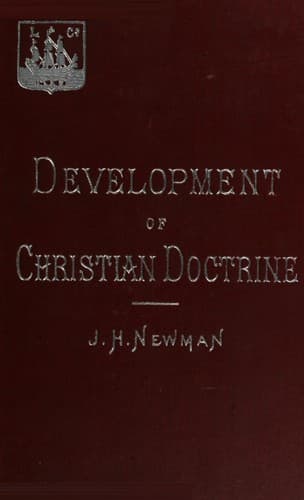
An Essay on the Development of Christian DoctrineNewman, John Henry
Religion
An Essay on the Development of Christian Doctrine
Newman, John Henry
Catholic Church -- Doctrines; Dogma, Development of
Thus in politics, too, ideas are sometimes proposed, discussed,
rejected, or adopted, as it may happen, and sometimes they are shown to
be unmeaning and impossible; sometimes they are true, but partially so,
or in subordination to other ideas, with which, in consequence, they are
as wholes or in part incorporated, as far as these have affinities to
them, the power to incorporate being thus recognized as a property of
life. Mr. Bentham's system was an attempt to make the circle of legal
and moral truths developments of certain principles of his own;--those
principles of his may, if it so happen, prove unequal to the weight of
truths which are eternal, and the system founded on them may break into
pieces; or again, a State may absorb certain of them, for which it has
affinity, that is, it may develope in Benthamism, yet remain in
substance what it was before. In the history of the French Revolution we
read of many middle parties, who attempted to form theories of
constitutions short of those which they would call extreme, and
successively failed from the want of power or reality in their
characteristic ideas. The Semi-arians attempted a middle way between
orthodoxy and heresy, but could not stand their ground; at length part
fell into Macedonianism, and part joined the Church.
5.
The stronger and more living is an idea, that is, the more powerful hold
it exercises on the minds of men, the more able is it to dispense with
safeguards, and trust to itself against the danger of corruption. As
strong frames exult in their agility, and healthy constitutions throw
off ailments, so parties or schools that live can afford to be rash, and
will sometimes be betrayed into extravagances, yet are brought right by
their inherent vigour. On the other hand, unreal systems are commonly
decent externally. Forms, subscriptions, or Articles of religion are
indispensable when the principle of life is weakly. Thus Presbyterianism
has maintained its original theology in Scotland where legal
subscriptions are enforced, while it has run into Arianism or
Unitarianism where that protection is away. We have yet to see whether
the Free Kirk can keep its present theological ground. The Church of
Rome can consult expedience more freely than other bodies, as trusting
to her living tradition, and is sometimes thought to disregard principle
and scruple, when she is but dispensing with forms. Thus Saints are
often characterized by acts which are no pattern for others; and the
most gifted men are, by reason of their very gifts, sometimes led into
fatal inadvertences. Hence vows are the wise defence of unstable virtue,
and general rules the refuge of feeble authority.
And so much may suffice on the _unitive power_ of faithful developments,
which constitutes their third characteristic.
SECTION IV.
FOURTH NOTE. LOGICAL SEQUENCE.
Public-domain text, read in full here on John Shaqi.
Reviews
Reviews
No reviews yet
Be the first to share your thoughts on this work.
Elsewhere in the archive
Join the Discussion
Join the discussion
Sign in to leave a comment or review.
Sign InorCreate an account