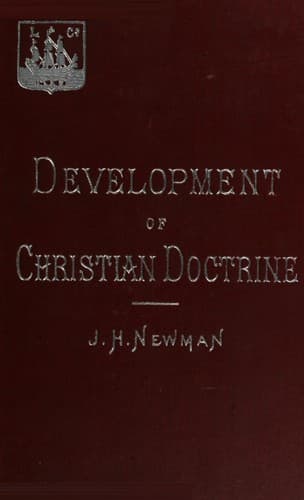
An Essay on the Development of Christian DoctrineNewman, John Henry
Religion
An Essay on the Development of Christian Doctrine
Newman, John Henry
Catholic Church -- Doctrines; Dogma, Development of
The process of development, thus capable of a logical expression, has
sometimes been invidiously spoken of as rationalism and contrasted with
faith. But, though a particular doctrine or opinion which is subjected
to development may happen to be rationalistic, and, as is the original,
such are its results: and though we may develope erroneously, that is,
reason incorrectly, yet the developing itself as little deserves that
imputation in any case, as an inquiry into an historical fact, which we
do not thereby make but ascertain,--for instance, whether or not St.
Mark wrote his Gospel with St. Matthew before him, or whether Solomon
brought his merchandise from Tartessus or some Indian port. Rationalism
is the exercise of reason instead of faith in matters of faith; but one
does not see how it can be faith to adopt the premisses, and unbelief to
accept the conclusion.
At the same time it may be granted that the spontaneous process which
goes on within the mind itself is higher and choicer than that which is
logical; for the latter, being scientific, is common property, and can
be taken and made use of by minds who are personally strangers, in any
true sense, both to the ideas in question and to their development.
3.
Thus, the holy Apostles would without words know all the truths
concerning the high doctrines of theology, which controversialists
after them have piously and charitably reduced to formulæ, and developed
through argument. Thus, St. Justin or St. Irenæus might be without any
digested ideas of Purgatory or Original Sin, yet have an intense
feeling, which they had not defined or located, both of the fault of our
first nature and the responsibilities of our nature regenerate. Thus St.
Antony said to the philosophers who came to mock him, "He whose mind is
in health does not need letters;" and St. Ignatius Loyola, while yet an
unlearned neophyte, was favoured with transcendent perceptions of the
Holy Trinity during his penance at Manresa. Thus St. Athanasius himself
is more powerful in statement and exposition than in proof; while in
Bellarmine we find the whole series of doctrines carefully drawn out,
duly adjusted with one another, and exactly analyzed one by one.
The history of empires and of public men supplies so many instances of
logical development in the field of politics, that it is needless to do
more than to refer to one of them. It is illustrated by the words of
Jeroboam, "Now shall this kingdom return to the house of David, if this
people go up to do sacrifice in the house of the Lord at Jerusalem. . .
Wherefore the king took counsel and made two calves of gold, and said
unto them, Behold thy gods, O Israel." Idolatry was a duty of kingcraft
with the schismatical kingdom.
4.
Public-domain text, read in full here on John Shaqi.
Reviews
Reviews
No reviews yet
Be the first to share your thoughts on this work.
Elsewhere in the archive
Join the Discussion
Join the discussion
Sign in to leave a comment or review.
Sign InorCreate an account