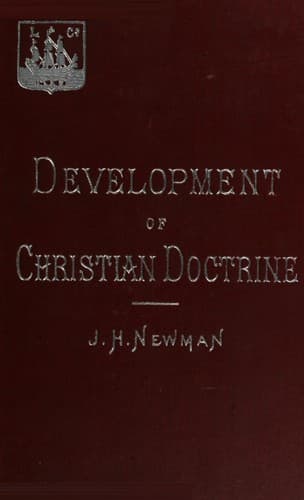
An Essay on the Development of Christian DoctrineNewman, John Henry
Religion
An Essay on the Development of Christian Doctrine
Newman, John Henry
Catholic Church -- Doctrines; Dogma, Development of
All three writers, Tacitus, Suetonius, and Pliny, call it a
"superstition;" this is no accidental imputation, but is repeated by a
variety of subsequent writers and speakers. The charge of Thyestean
banquets scarcely lasts a hundred years; but, while pagan witnesses are
to be found, the Church is accused of superstition. The heathen
disputant in Minucius calls Christianity, "_Vana et demens
superstitio_." The lawyer Modestinus speaks, with an apparent allusion
to Christianity, of "weak minds being terrified _superstitione
numinis_." The heathen magistrate asks St. Marcellus, whether he and
others have put away "vain superstitions," and worship the gods whom the
emperors worship. The Pagans in Arnobius speak of Christianity as "an
execrable and unlucky religion, full of impiety and sacrilege,
contaminating the rites instituted from of old with the superstition of
its novelty." The anonymous opponent of Lactantius calls it, "_Impia et
anilis superstitio_." Diocletian's inscription at Clunia was, as it
declared, on occasion of "the total extinction of the superstition of
the Christians, and the extension of the worship of the gods." Maximin,
in his Letter upon Constantine's Edict, still calls it a
superstition.[225:1]
16.
Now what is meant by the word thus attached by a _consensus_ of heathen
authorities to Christianity? At least, it cannot mean a religion in
which a man might think what he pleased, and was set free from all
yokes, whether of ignorance, fear, authority, or priestcraft. When
heathen writers call the Oriental rites superstitions, they evidently
use the word in its modern sense; it cannot surely be doubted that they
apply it in the same sense to Christianity. But Plutarch explains for us
the word at length, in his Treatise which bears the name: "Of all kinds
of fear," he says, "superstition is the most fatal to action and
resource. He does not fear the sea who does not sail, nor war who does
not serve, nor robbers who keeps at home, nor the sycophant who is poor,
nor the envious if he is a private man, nor an earthquake if he lives in
Gaul, nor thunder if he lives in Ethiopia; but he who fears the gods
fears everything, earth, seas, air, sky, darkness, light, noises,
silence, sleep. Slaves sleep and forget their masters; of the fettered
doth sleep lighten the chain; inflamed wounds, ulcers cruel and
agonizing, are not felt by the sleeping. Superstition alone has come to
no terms with sleep; but in the very sleep of her victims, as though
they were in the realms of the impious, she raises horrible spectres,
and monstrous phantoms, and various pains, and whirls the miserable soul
about, and persecutes it. They rise, and, instead of making light of
what is unreal, they fall into the hands of quacks and conjurers, who
say, 'Call the crone to expiate, bathe in the sea, and sit all day on
the ground.'" He goes on to speak of the introduction of "uncouth names
and barbarous terms" into "the divine and national authority of
Public-domain text, read in full here on John Shaqi.
Reviews
Reviews
No reviews yet
Be the first to share your thoughts on this work.
Elsewhere in the archive
Join the Discussion
Join the discussion
Sign in to leave a comment or review.
Sign InorCreate an account