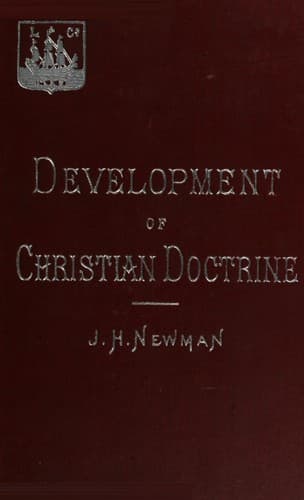
An Essay on the Development of Christian DoctrineNewman, John Henry
Religion
An Essay on the Development of Christian Doctrine
Newman, John Henry
Catholic Church -- Doctrines; Dogma, Development of
Such was Christianity in the eyes of those who witnessed its rise and
propagation;--one of a number of wild and barbarous rites which were
pouring in upon the Empire from the ancient realms of superstition, and
the mother of a progeny of sects which were faithful to the original
they had derived from Egypt or Syria; a religion unworthy of an educated
person, as appealing, not to the intellect, but to the fears and
weaknesses of human nature, and consisting, not in the rational and
cheerful enjoyment, but in a morose rejection of the gifts of
Providence; a horrible religion, as inflicting or enjoining cruel
sufferings, and monstrous and loathsome in its very indulgence of the
passions; a religion leading by reaction to infidelity; a religion of
magic, and of the vulgar arts, real and pretended, with which magic was
accompanied; a secret religion which dared not face the day; an
itinerant, busy, proselytizing religion, forming an extended confederacy
against the state, resisting its authority and breaking its laws. There
may be some exceptions to this general impression, such as Pliny's
discovery of the innocent and virtuous rule of life adopted by the
Christians of Pontus; but this only proves that Christianity was not in
fact the infamous religion which the heathen thought it; it did not
reverse their general belief to that effect.
27.
Now it must be granted that, in some respects, this view of Christianity
depended on the times, and would alter with their alteration. When there
was no persecution, Martyrs could not be obstinate; and when the Church
was raised aloft in high places, it was no longer in caves. Still, I
believe, it continued substantially the same in the judgment of the
world external to it, while there was an external world to judge of it.
"They thought it enough," says Julian in the fourth century, of our Lord
and His Apostles, "to deceive women, servants, and slaves, and by their
means wives and husbands." "A human fabrication," says he elsewhere,
"put together by wickedness, having nothing divine in it, but making a
perverted use of the fable-loving, childish, irrational part of the
soul, and offering a set of wonders to create belief." "Miserable men,"
he says elsewhere, "you refuse to worship the ancile, yet you worship
the wood of the cross, and sign it on your foreheads, and fix it on your
doors. Shall one for this hate the intelligent among you, or pity the
less understanding, who in following you have gone to such an excess of
perdition as to leave the everlasting gods and go over to a dead Jew?"
He speaks of their adding other dead men to Him who died so long ago.
"You have filled all places with sepulchres and monuments, though it is
nowhere told you in your religion to haunt the tombs and to attend upon
them." Elsewhere he speaks of their "leaving the gods for corpses and
relics." On the other hand, he attributes the growth of Christianity to
its humanity towards strangers, care in burying the dead, and pretended
Public-domain text, read in full here on John Shaqi.
Reviews
Reviews
No reviews yet
Be the first to share your thoughts on this work.
Elsewhere in the archive
Join the Discussion
Join the discussion
Sign in to leave a comment or review.
Sign InorCreate an account