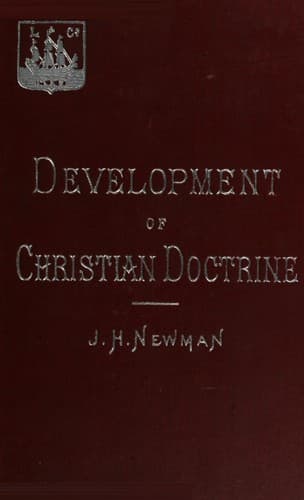
An Essay on the Development of Christian DoctrineNewman, John Henry
Religion
An Essay on the Development of Christian Doctrine
Newman, John Henry
Catholic Church -- Doctrines; Dogma, Development of
These sects were of very various character. Learning, eloquence, and
talent were the characteristics of the Apollinarians, Manichees, and
Pelagians; Tichonius the Donatist was distinguished in Biblical
interpretation; the Semi-arian and Apollinarian leaders were men of
grave and correct behaviour; the Novatians had sided with the Orthodox
during the Arian persecution; the Montanists and Messalians addressed
themselves to an almost heathen population; the atrocious fanaticism of
the Priscillianists, the fury of the Arian women of Alexandria and
Constantinople, and the savage cruelty of the Circumcellions can hardly
be exaggerated. These various sectaries had their orders of clergy,
bishops, priests and deacons; their readers and ministers; their
celebrants and altars; their hymns and litanies. They preached to the
crowds in public, and their meeting-houses bore the semblance of
churches. They had their sacristies and cemeteries; their farms; their
professors and doctors; their schools. Miracles were ascribed to the
Arian Theophilus, to the Luciferian Gregory of Elvira, to a Macedonian
in Cyzicus, and to the Donatists in Africa.
4.
How was an individual inquirer to find, or a private Christian to keep
the Truth, amid so many rival teachers? The misfortunes or perils of
holy men and saints show us the difficulty; St. Augustine was nine years
a Manichee; St. Basil for a time was in admiration of the Semi-arians;
St. Sulpicius gave a momentary countenance to the Pelagians; St. Paula
listened, and Melania assented, to the Origenists. Yet the rule was
simple, which would direct every one right; and in that age, at least,
no one could be wrong for any long time without his own fault. The
Church is everywhere, but it is one; sects are everywhere, but they are
many, independent and discordant. Catholicity is the attribute of the
Church, independency of sectaries. It is true that some sects might seem
almost Catholic in their diffusion; Novatians or Marcionites were in all
quarters of the empire; yet it is hardly more than the name, or the
general doctrine or philosophy, that was universal: the different
portions which professed it seem to have been bound together by no
strict or definite tie. The Church might be evanescent or lost for a
while in particular countries, or it might be levelled and buried among
sects, when the eye was confined to one spot, or it might be confronted
by the one and same heresy in various places; but, on looking round the
_orbis terrarum_, there was no mistaking that body which, and which
alone, had possession of it. The Church is a kingdom; a heresy is a
family rather than a kingdom; and as a family continually divides and
sends out branches, founding new houses, and propagating itself in
colonies, each of them as independent as its original head, so was it
with heresy. Simon Magus, the first heretic, had been Patriarch of
Menandrians, Basilidians, Valentinians, and the whole family of
Public-domain text, read in full here on John Shaqi.
Reviews
Reviews
No reviews yet
Be the first to share your thoughts on this work.
Elsewhere in the archive
Join the Discussion
Join the discussion
Sign in to leave a comment or review.
Sign InorCreate an account