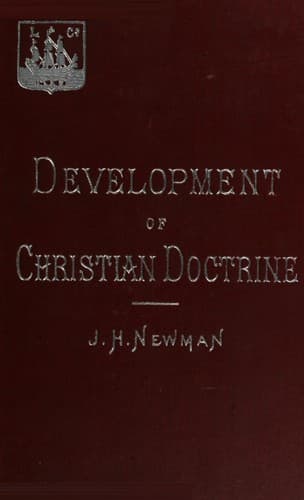
An Essay on the Development of Christian DoctrineNewman, John Henry
Religion
An Essay on the Development of Christian Doctrine
Newman, John Henry
Catholic Church -- Doctrines; Dogma, Development of
The deep meditation which seems to have been exercised by the Fathers on
points of doctrine, the disputes and turbulence yet lucid determination
which characterize the Councils, the indecision of Popes, are all in
different ways, at least when viewed together, portions and indications
of the same process. The theology of the Church is no random combination
of various opinions, but a diligent, patient working out of one doctrine
from many materials. The conduct of Popes, Councils, Fathers, betokens
the slow, painful, anxious taking up of new truths into an existing body
of belief. St. Athanasius, St. Augustine, St. Leo are conspicuous for
the repetition _in terminis_ of their own theological statements; on the
contrary, it has been observed of the heterodox Tertullian, that his
works "indicate no ordinary fertility of mind in that he so little
repeats himself or recurs to favourite thoughts, as is frequently the
case even with the great St. Augustine."[366:2]
11.
Here we see the difference between originality of mind and the gift and
calling of a Doctor in the Church; the holy Fathers just mentioned were
intently fixing their minds on what they taught, grasping it more and
more closely, viewing it on various sides, trying its consistency,
weighing their own separate expressions. And thus if in some cases they
were even left in ignorance, the next generation of teachers completed
their work, for the same unwearied anxious process of thought went on.
St. Gregory Nyssen finishes the investigations of St. Athanasius; St.
Leo guards the polemical statements of St. Cyril. Clement may hold a
purgatory, yet tend to consider all punishment purgatorial; St. Cyprian
may hold the unsanctified state of heretics, but include in his doctrine
a denial of their baptism; St. Hippolytus may believe in the personal
existence of the Word from eternity, yet speak confusedly on the
eternity of His Sonship; the Council of Antioch might put aside the
Homoüsion, and the Council of Nicæa impose it; St. Hilary may believe in
a purgatory, yet confine it to the day of judgment; St. Athanasius and
other Fathers may treat with almost supernatural exactness the doctrine
of our Lord's incarnation, yet imply, as far as words go, that He was
ignorant viewed in His human nature; the Athanasian Creed may admit the
illustration of soul and body, and later Fathers may discountenance it;
St. Augustine might first be opposed to the employment of force in
religion, and then acquiesce in it. Prayers for the faithful departed
may be found in the early liturgies, yet with an indistinctness which
included the Blessed Virgin and the Martyrs in the same rank with the
imperfect Christian whose sins were as yet unexpiated; and succeeding
times might keep what was exact, and supply what was deficient.
Aristotle might be reprobated by certain early Fathers, yet furnish the
phraseology for theological definitions afterwards. And in a different
subject-matter, St.
Public-domain text, read in full here on John Shaqi.
Reviews
Reviews
No reviews yet
Be the first to share your thoughts on this work.
Elsewhere in the archive
Join the Discussion
Join the discussion
Sign in to leave a comment or review.
Sign InorCreate an account