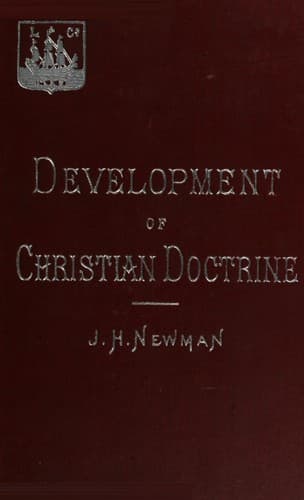
An Essay on the Development of Christian DoctrineNewman, John Henry
Religion
An Essay on the Development of Christian Doctrine
Newman, John Henry
Catholic Church -- Doctrines; Dogma, Development of
Parallel instances occur of the operation of this principle in the
history of the Church, from the time that the Apostles were taken from
it. St. Paul denounces distinctions in meat and drink, the observance of
Sabbaths and holydays, and of ordinances, and the worship of Angels; yet
Christians, from the first, were rigid in their stated fastings,
venerated, as St. Justin tells us, the Angelic intelligences,[369:1] and
established the observance of the Lord's day as soon as persecution
ceased.
3.
In like manner Celsus objects that Christians did not "endure the sight
of temples, altars, and statues;" Porphyry, that "they blame the rites
of worship, victims, and frankincense;" the heathen disputant in
Minucius asks, "Why have Christians no altars, no temples, no
conspicuous images?" and "no sacrifices;" and yet it is plain from
Tertullian that Christians had altars of their own, and sacrifices and
priests. And that they had churches is again and again proved by
Eusebius who had seen "the houses of prayer levelled" in the Dioclesian
persecution; from the history too of St. Gregory Thaumaturgus, nay from
Clement.[370:1] Again, St. Justin and Minucius speak of the form of the
Cross in terms of reverence, quite inconsistent with the doctrine that
external emblems of religion may not be venerated. Tertullian speaks of
Christians signing themselves with it whatever they set about, whether
they walk, eat, or lie down to sleep. In Eusebius's life of Constantine,
the figure of the Cross holds a most conspicuous place; the Emperor sees
it in the sky and is converted; he places it upon his standards; he
inserts it into his own hand when he puts up his statue; wherever the
Cross is displayed in his battles, he conquers; he appoints fifty men to
carry it; he engraves it on his soldiers' arms; and Licinius dreads its
power. Shortly after, Julian plainly accuses Christians of worshipping
the wood of the Cross, though they refused to worship the _ancile_. In a
later age the worship of images was introduced.[370:2]
4.
Public-domain text, read in full here on John Shaqi.
Reviews
Reviews
No reviews yet
Be the first to share your thoughts on this work.
Elsewhere in the archive
Join the Discussion
Join the discussion
Sign in to leave a comment or review.
Sign InorCreate an account