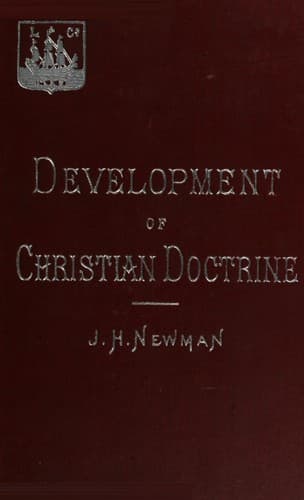
An Essay on the Development of Christian DoctrineNewman, John Henry
Religion
An Essay on the Development of Christian Doctrine
Newman, John Henry
Catholic Church -- Doctrines; Dogma, Development of
The example set by St. Gregory in an age of persecution was impetuously
followed when a time of peace succeeded. In the course of the fourth
century two movements or developments spread over the face of
Christendom, with a rapidity characteristic of the Church; the one
ascetic, the other ritual or ceremonial. We are told in various ways by
Eusebius,[373:1] that Constantine, in order to recommend the new
religion to the heathen, transferred into it the outward ornaments to
which they had been accustomed in their own. It is not necessary to go
into a subject which the diligence of Protestant writers has made
familiar to most of us. The use of temples, and these dedicated to
particular saints, and ornamented on occasions with branches of trees;
incense, lamps, and candles; votive offerings on recovery from illness;
holy water; asylums; holydays and seasons, use of calendars,
processions, blessings on the fields; sacerdotal vestments, the tonsure,
the ring in marriage, turning to the East, images at a later date,
perhaps the ecclesiastical chant, and the Kyrie Eleison,[373:2] are all
of pagan origin, and sanctified by their adoption into the Church.
7.
The eighth book of Theodoret's work _Adversus Gentiles_, which is "On
the Martyrs," treats so largely on the subject, that we must content
ourselves with only a specimen of the illustrations which it affords, of
the principle acted on by St. Gregory Thaumaturgus. "Time, which makes
all things decay," he says, speaking of the Martyrs, "has preserved
their glory incorruptible. For as the noble souls of those conquerors
traverse the heavens, and take part in the spiritual choirs, so their
bodies are not consigned to separate tombs, but cities and towns divide
them among them; and call them saviours of souls and bodies, and
physicians, and honour them as the protectors and guardians of cities,
and, using their intervention with the Lord of all, obtain through them
divine gifts. And though each body be divided, the grace remains
indivisible; and that small, that tiny particle is equal in power with
the Martyr that hath never been dispersed about. For the grace which is
ever blossoming distributes the gifts, measuring the bounty according to
the faith of those who come for it.
"Yet not even this persuades you to celebrate their God, but ye laugh
and mock at the honour which is paid them by all, and consider it a
pollution to approach their tombs. But though all men made a jest of
them, yet at least the Greeks could not decently complain, to whom
belonged libations and expiations, and heroes and demi-gods and deified
men. To Hercules, though a man . . . and compelled to serve Eurystheus,
they built temples, and constructed altars, and offered sacrifices in
honour, and allotted feasts; and that, not Spartans only and Athenians,
but the whole of Greece and the greater part of Europe."
8.
Public-domain text, read in full here on John Shaqi.
Reviews
Reviews
No reviews yet
Be the first to share your thoughts on this work.
Elsewhere in the archive
Join the Discussion
Join the discussion
Sign in to leave a comment or review.
Sign InorCreate an account