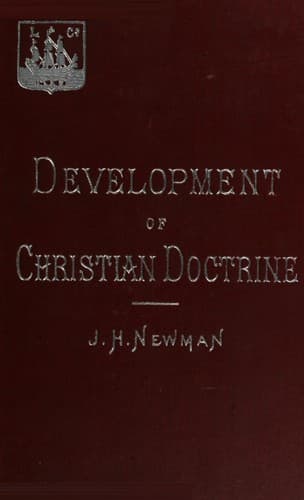
An Essay on the Development of Christian DoctrineNewman, John Henry
Religion
An Essay on the Development of Christian Doctrine
Newman, John Henry
Catholic Church -- Doctrines; Dogma, Development of
"The phenomenon, admitted on all hands, is this:--That great
portion of what is generally received as Christian truth is,
in its rudiments or in its separate parts, to be found in
heathen philosophies and religions. For instance, the doctrine
of a Trinity is found both in the East and in the West; so is
the ceremony of washing; so is the rite of sacrifice. The
doctrine of the Divine Word is Platonic; the doctrine of the
Incarnation is Indian; of a divine kingdom is Judaic; of
Angels and demons is Magian; the connexion of sin with the
body is Gnostic; celibacy is known to Bonze and Talapoin; a
sacerdotal order is Egyptian; the idea of a new birth is
Chinese and Eleusinian; belief in sacramental virtue is
Pythagorean; and honours to the dead are a polytheism. Such is
the general nature of the fact before us; Mr. Milman argues
from it,--'These things are in heathenism, therefore they are
not Christian:' we, on the contrary, prefer to say, 'these
things are in Christianity, therefore they are not heathen.'
That is, we prefer to say, and we think that Scripture bears
us out in saying, that from the beginning the Moral Governor
of the world has scattered the seeds of truth far and wide
over its extent; that these have variously taken root, and
grown up as in the wilderness, wild plants indeed but living;
and hence that, as the inferior animals have tokens of an
immaterial principle in them, yet have not souls, so the
philosophies and religions of men have their life in certain
true ideas, though they are not directly divine. What man is
amid the brute creation, such is the Church among the schools
of the world; and as Adam gave names to the animals about him,
so has the Church from the first looked round upon the earth,
noting and visiting the doctrines she found there. She began
in Chaldea, and then sojourned among the Canaanites, and went
down into Egypt, and thence passed into Arabia, till she
rested in her own land. Next she encountered the merchants of
Tyre, and the wisdom of the East country, and the luxury of
Sheba. Then she was carried away to Babylon, and wandered to
the schools of Greece. And wherever she went, in trouble or in
triumph, still she was a living spirit, the mind and voice of
the Most High; 'sitting in the midst of the doctors, both
hearing them and asking them questions;' claiming to herself
what they said rightly, correcting their errors, supplying
their defects, completing their beginnings, expanding their
surmises, and thus gradually by means of them enlarging the
range and refining the sense of her own teaching. So far then
from her creed being of doubtful credit because it resembles
foreign theologies, we even hold that one special way in which
Public-domain text, read in full here on John Shaqi.
Reviews
Reviews
No reviews yet
Be the first to share your thoughts on this work.
Elsewhere in the archive
Join the Discussion
Join the discussion
Sign in to leave a comment or review.
Sign InorCreate an account