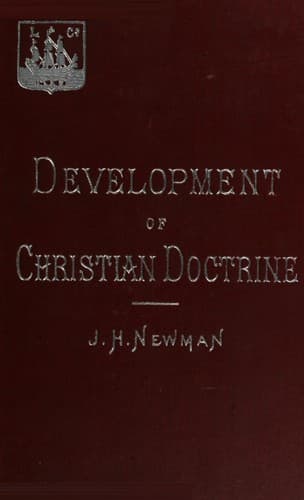
An Essay on the Development of Christian DoctrineNewman, John Henry
Religion
An Essay on the Development of Christian Doctrine
Newman, John Henry
Catholic Church -- Doctrines; Dogma, Development of
"Various suppositions have, accordingly, been made, as pure
suppositions, as mere specimens of the capabilities (if one may so
speak) of the Divine Dispensation, as efforts of the mind reaching
forward and venturing beyond its depth into the abyss of the Divine
Counsels. If one supposition could be hazarded, sufficient to solve the
problem, the existence of ten thousand others is conceivable, unless
indeed the resources of God's Providence are exactly commensurate with
man's discernment of them. Religious men, amid these searchings of
heart, have naturally gone to Scripture for relief; to see if the
inspired word anywhere gave them any clue for their inquiries. And from
what was there found, and from the speculations of reason upon it,
various notions have been hazarded at different times; for instance,
that there is a certain momentary ordeal to be undergone by all men
after this life, more or less severe according to their spiritual
state; or that certain gross sins in good men will be thus visited, or
their lighter failings and habitual imperfections; or that the very
sight of Divine Perfection in the invisible world will be in itself a
pain, while it constitutes the purification of the imperfect but
believing soul; or that, happiness admitting of various degrees of
intensity, penitents late in life may sink for ever into a state,
blissful as far as it goes, but more or less approaching to
unconsciousness; and infants dying after baptism may be as gems paving
the courts of heaven, or as the living wheels of the Prophet's vision;
while matured Saints may excel in capacity of bliss, as well as in
dignity, the highest Archangels.
6.
"Now, as to the punishments and satisfactions for sin, the texts to
which the minds of the early Christians seem to have been principally
drawn, and from which they ventured to argue in behalf of these vague
notions, were these two: 'The fire shall try every man's work,' &c., and
'He shall baptize you with the Holy Ghost and with fire.' These
passages, with which many more were found to accord, directed their
thoughts one way, as making mention of 'fire,' whatever was meant by the
word, as the instrument of trial and purification; and that, at some
time between the present time and the Judgment, or at the Judgment.
"As the doctrine, thus suggested by certain striking texts, grew in
popularity and definiteness, and verged towards its present Roman form,
it seemed a key to many others. Great portions of the books of Psalms,
Job, and the Lamentations, which express the feelings of religious men
under suffering, would powerfully recommend it by the forcible and most
affecting and awful meaning which they received from it. When this was
once suggested, all other meanings would seem tame and inadequate.
Public-domain text, read in full here on John Shaqi.
Reviews
Reviews
No reviews yet
Be the first to share your thoughts on this work.
Elsewhere in the archive
Join the Discussion
Join the discussion
Sign in to leave a comment or review.
Sign InorCreate an account