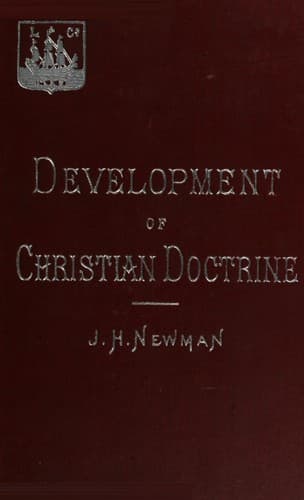
An Essay on the Development of Christian DoctrineNewman, John Henry
Religion
An Essay on the Development of Christian Doctrine
Newman, John Henry
Catholic Church -- Doctrines; Dogma, Development of
Nor can it be fairly objected that in thus arguing we are contradicting
the great philosopher, who tells us, that "upon supposition of God
affording us light and instruction by revelation, additional to what He
has afforded us by reason and experience, we are in no sort judges by
what methods, and in what proportion, it were to be expected that this
supernatural light and instruction would be afforded us,"[64:1] because
he is speaking of our judging before a revelation is given. He observes
that "we have no principles of reason upon which to judge _beforehand_,
how it were to be expected Revelation should have been left, or what was
most suitable to the divine plan of government," in various respects;
but the case is altogether altered when a Revelation is vouchsafed, for
then a new precedent, or what he calls "principle of reason," is
introduced, and from what is actually put into our hands we can form a
judgment whether more is to be expected. Butler, indeed, as a well-known
passage of his work shows, is far from denying the principle of
progressive development.
9.
5. The method of revelation observed in Scripture abundantly confirms
this anticipation. For instance, Prophecy, if it had so happened, need
not have afforded a specimen of development; separate predictions might
have been made to accumulate as time went on, prospects might have
opened, definite knowledge might have been given, by communications
independent of each other, as St. John's Gospel or the Epistles of St.
Paul are unconnected with the first three Gospels, though the doctrine
of each Apostle is a development of their matter. But the prophetic
Revelation is, in matter of fact, not of this nature, but a process of
development: the earlier prophecies are pregnant texts out of which the
succeeding announcements grow; they are types. It is not that first one
truth is told, then another; but the whole truth or large portions of it
are told at once, yet only in their rudiments, or in miniature, and they
are expanded and finished in their parts, as the course of revelation
proceeds.
Public-domain text, read in full here on John Shaqi.
Reviews
Reviews
No reviews yet
Be the first to share your thoughts on this work.
Elsewhere in the archive
Join the Discussion
Join the discussion
Sign in to leave a comment or review.
Sign InorCreate an account