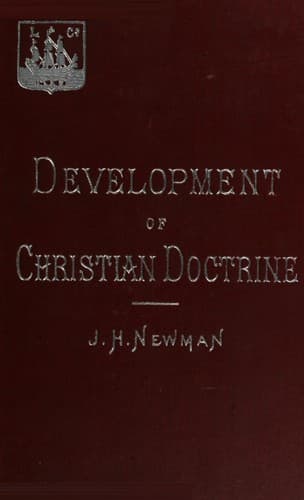
An Essay on the Development of Christian DoctrineNewman, John Henry
Religion
An Essay on the Development of Christian Doctrine
Newman, John Henry
Catholic Church -- Doctrines; Dogma, Development of
The Seed of the woman was to bruise the serpent's head; the sceptre was
not to depart from Judah till Shiloh came, to whom was to be the
gathering of the people. He was to be Wonderful, Counsellor, the Prince
of Peace. The question of the Ethiopian rises in the reader's mind, "Of
whom speaketh the Prophet this?" Every word requires a comment.
Accordingly, it is no uncommon theory with unbelievers, that the
Messianic idea, as they call it, was gradually developed in the minds of
the Jews by a continuous and traditional habit of contemplating it, and
grew into its full proportions by a mere human process; and so far seems
certain, without trenching on the doctrine of inspiration, that the
books of Wisdom and Ecclesiasticus are developments of the writings of
the Prophets, expressed or elicited by means of current ideas in the
Greek philosophy, and ultimately adopted and ratified by the Apostle in
his Epistle to the Hebrews.
10.
But the whole Bible, not its prophetical portions only, is written on
the principle of development. As the Revelation proceeds, it is ever
new, yet ever old. St. John, who completes it, declares that he writes
no "new commandment unto his brethren," but an old commandment which
they "had from the beginning." And then he adds, "A new commandment I
write unto you." The same test of development is suggested in our Lord's
words on the Mount, as has already been noticed, "Think not that I am
come to destroy the Law and the Prophets; I am not come to destroy, but
to fulfil." He does not reverse, but perfect, what has gone before. Thus
with respect to the evangelical view of the rite of sacrifice, first the
rite is enjoined by Moses; next Samuel says, "to obey is better than
sacrifice;" then Hosea, "I will have mercy and not sacrifice;" Isaiah,
"Incense is an abomination onto me;" then Malachi, describing the times
of the Gospel, speaks of the "pure offering" of wheatflour; and our Lord
completes the development, when He speaks of worshipping "in spirit and
in truth." If there is anything here left to explain, it will be found
in the usage of the Christian Church immediately afterwards, which shows
that sacrifice was not removed, but truth and spirit added.
Nay, the _effata_ of our Lord and His Apostles are of a typical
structure, parallel to the prophetic announcements above mentioned, and
predictions as well as injunctions of doctrine. If then the prophetic
sentences have had that development which has really been given them,
first by succeeding revelations, and then by the event, it is probable
antecedently that those doctrinal, political, ritual, and ethical
sentences, which have the same structure, should admit the same
expansion. Such are, "This is My Body," or "Thou art Peter, and upon
this Rock I will build My Church," or "The meek shall inherit the
earth," or "Suffer little children to come unto Me," or "The pure in
heart shall see God."
11.
Public-domain text, read in full here on John Shaqi.
Reviews
Reviews
No reviews yet
Be the first to share your thoughts on this work.
Elsewhere in the archive
Join the Discussion
Join the discussion
Sign in to leave a comment or review.
Sign InorCreate an account