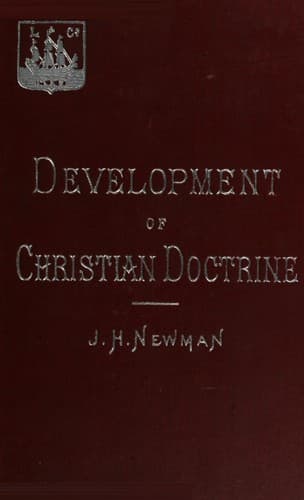
An Essay on the Development of Christian DoctrineNewman, John Henry
Religion
An Essay on the Development of Christian Doctrine
Newman, John Henry
Catholic Church -- Doctrines; Dogma, Development of
covenant that "the Spirit of the Lord that is upon her, and His words
which He has put in her mouth shall not depart out of her mouth, nor out
of the mouth of her seed, nor out of the mouth of her seed's seed, from
henceforth and for ever."[89:1]
13.
7. And if the very claim to infallible arbitration in religious disputes
is of so weighty importance and interest in all ages of the world, much
more is it welcome at a time like the present, when the human intellect
is so busy, and thought so fertile, and opinion so manifold. The
absolute need of a spiritual supremacy is at present the strongest of
arguments in favour of the fact of its supply. Surely, either an
objective revelation has not been given, or it has been provided with
means for impressing its objectiveness on the world. If Christianity be
a social religion, as it certainly is, and if it be based on certain
ideas acknowledged as divine, or a creed, (which shall here be assumed,)
and if these ideas have various aspects, and make distinct impressions
on different minds, and issue in consequence in a multiplicity of
developments, true, or false, or mixed, as has been shown, what power
will suffice to meet and to do justice to these conflicting conditions,
but a supreme authority ruling and reconciling individual judgments by a
divine right and a recognized wisdom? In barbarous times the will is
reached through the senses; but in an age in which reason, as it is
called, is the standard of truth and right, it is abundantly evident to
any one, who mixes ever so little with the world, that, if things are
left to themselves, every individual will have his own view of them, and
take his own course; that two or three will agree to-day to part company
to-morrow; that Scripture will be read in contrary ways, and history,
according to the apologue, will have to different comers its silver
shield and its golden; that philosophy, taste, prejudice, passion,
party, caprice, will find no common measure, unless there be some
supreme power to control the mind and to compel agreement.
Public-domain text, read in full here on John Shaqi.
Reviews
Reviews
No reviews yet
Be the first to share your thoughts on this work.
Elsewhere in the archive
Join the Discussion
Join the discussion
Sign in to leave a comment or review.
Sign InorCreate an account