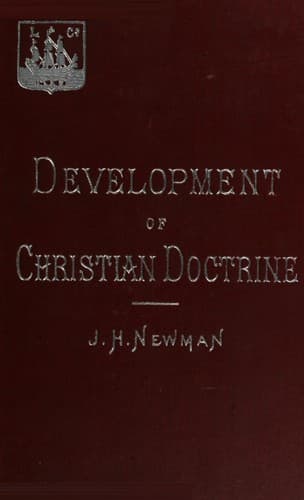
An Essay on the Development of Christian DoctrineNewman, John Henry
Religion
An Essay on the Development of Christian Doctrine
Newman, John Henry
Catholic Church -- Doctrines; Dogma, Development of
And this general testimony to the oneness of Catholicism extends to its
past teaching relatively to its present, as well as to the portions of
its present teaching one with another. No one doubts, with such
exception as has just been allowed, that the Roman Catholic communion of
this day is the successor and representative of the Medieval Church, or
that the Medieval Church is the legitimate heir of the Nicene; even
allowing that it is a question whether a line cannot be drawn between
the Nicene Church and the Church which preceded it. On the whole, all
parties will agree that, of all existing systems, the present communion
of Rome is the nearest approximation in fact to the Church of the
Fathers, possible though some may think it, to be nearer still to that
Church on paper. Did St. Athanasius or St. Ambrose come suddenly to
life, it cannot be doubted what communion he would take to be his own.
All surely will agree that these Fathers, with whatever opinions of
their own, whatever protests, if we will, would find themselves more at
home with such men as St. Bernard or St. Ignatius Loyola, or with the
lonely priest in his lodging, or the holy sisterhood of mercy, or the
unlettered crowd before the altar, than with the teachers or with the
members of any other creed. And may we not add, that were those same
Saints, who once sojourned, one in exile, one on embassy, at Treves, to
come more northward still, and to travel until they reached another fair
city, seated among groves, green meadows, and calm streams, the holy
brothers would turn from many a high aisle and solemn cloister which
they found there, and ask the way to some small chapel where mass was
said in the populous alley or forlorn suburb? And, on the other hand,
can any one who has but heard his name, and cursorily read his history,
doubt for one instant how, in turn, the people of England, "we, our
princes, our priests, and our prophets," Lords and Commons,
Universities, Ecclesiastical Courts, marts of commerce, great towns,
country parishes, would deal with Athanasius,--Athanasius, who spent his
long years in fighting against sovereigns for a theological term?
FOOTNOTES:
[62:1] Doctrine of Justification, Lect. xiii.
[64:1] Butler's Anal. ii. 3.
[67:1] Proph. Office, Lect. xii. [Via Med. vol. i. pp. 292-3].
[72:1] ii. 3; vide also ii. 4, fin.
[75:1] Analogy, ii. 4, _ad fin._
[77:1] Proph. Office, x. [Via Med. p. 250].
[77:2] [Ibid. pp. 247, 254.]
[79:1] Arians, ch. i. sect. 3 [p. 82, ed. 3].
[81:1] Proph. Office [Via Med. vol. i. p. 122].
Public-domain text, read in full here on John Shaqi.
Reviews
Reviews
No reviews yet
Be the first to share your thoughts on this work.
Elsewhere in the archive
Join the Discussion
Join the discussion
Sign in to leave a comment or review.
Sign InorCreate an account