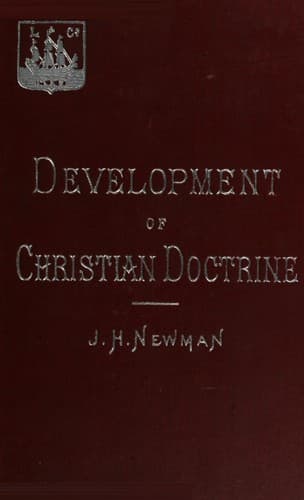
An Essay on the Development of Christian DoctrineNewman, John Henry
Religion
An Essay on the Development of Christian Doctrine
Newman, John Henry
Catholic Church -- Doctrines; Dogma, Development of
came to the inspired text by himself, beyond the influence of that
traditional acceptation which happily encompasses it, would be surprised
to be told that the Prophet's words, "A virgin shall conceive," &c., or
"Let all the Angels of God worship Him," refer to our Lord; but assuming
the intimate connexion between Judaism and Christianity, and the
inspiration of the New Testament, we do not scruple to believe it. We
rightly feel that it is no prejudice to our receiving the prophecy of
Balaam in its Christian meaning, that it is adequately fulfilled in
David; or the history of Jonah, that it is poetical in character and has
a moral in itself like an apologue; or the meeting of Abraham and
Melchizedek, that it is too brief and simple to mean any great thing, as
St. Paul interprets it.
5.
Butler corroborates these remarks, when speaking of the particular
evidence for Christianity. "The obscurity or unintelligibleness," he
says, "of one part of a prophecy does not in any degree invalidate the
proof of foresight, arising from the appearing completion of those other
parts which are understood. For the case is evidently the same as if
those parts, which are not understood, were lost, or not written at all,
or written in an unknown tongue. Whether this observation be commonly
attended to or not, it is so evident that one can scarce bring one's
self to set down an instance in common matters to exemplify it."[104:1]
He continues, "Though a man should be incapable, for want of learning,
or opportunities of inquiry, or from not having turned his studies this
way, even so much as to judge whether particular prophecies have been
throughout completely fulfilled; yet he may see, in general, that they
have been fulfilled to such a degree, as, upon very good ground, to be
convinced of foresight more than human in such prophecies, and of such
events being intended by them. For the same reason also, though, by
means of the deficiencies in civil history, and the different accounts
of historians, the most learned should not be able to make out to
satisfaction that such parts of the prophetic history have been minutely
and throughout fulfilled; yet a very strong proof of foresight may arise
from that general completion of them which is made out; as much proof of
foresight, perhaps, as the Giver of prophecy intended should ever be
afforded by such parts of prophecy."
6.
Public-domain text, read in full here on John Shaqi.
Reviews
Reviews
No reviews yet
Be the first to share your thoughts on this work.
Elsewhere in the archive
Join the Discussion
Join the discussion
Sign in to leave a comment or review.
Sign InorCreate an account