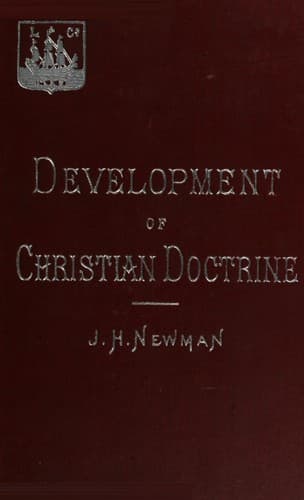
An Essay on the Development of Christian DoctrineNewman, John Henry
Religion
An Essay on the Development of Christian Doctrine
Newman, John Henry
Catholic Church -- Doctrines; Dogma, Development of
Sometimes when the want of evidence for a series of facts or doctrines
is unaccountable, an unexpected explanation or addition in the course of
time is found as regards a portion of them, which suggests a ground of
patience as regards the historical obscurity of the rest. Two instances
are obvious to mention, of an accidental silence of clear primitive
testimony as to important doctrines, and its removal. In the number of
the articles of Catholic belief which the Reformation especially
resisted, were the Mass and the sacramental virtue of Ecclesiastical
Unity. Since the date of that movement, the shorter Epistles of St.
Ignatius have been discovered, and the early Liturgies verified; and
this with most men has put an end to the controversy about those
doctrines. The good fortune which has happened to them, may happen to
others; and though it does not, yet that it has happened to them, is to
those others a sort of compensation for the obscurity in which their
early history continues to be involved.
11.
I may seem in these remarks to be preparing the way for a broad
admission of the absence of any sanction in primitive Christianity in
behalf of its medieval form, but I do not make them with this intention.
Not from misgivings of this kind, but from the claims of a sound logic,
I think it right to insist, that, whatever early testimonies I may bring
in support of later developments of doctrine, are in great measure
brought _ex abundante_, a matter of grace, not of compulsion. The _onus
probandi_ is with those who assail a teaching which is, and has long
been, in possession. As for positive evidence in our behalf, they must
take what they can get, if they cannot get as much as they might wish,
inasmuch as antecedent probabilities, as I have said, go so very far
towards dispensing with it. It is a first strong point that, in an idea
such as Christianity, developments cannot but be, and those surely
divine, because it is divine; a second that, if so, they are those very
ones which exist, because there are no others; and a third point is the
fact that they are found just there, where true developments ought to be
found,--namely, in the historic seats of Apostolical teaching and in the
authoritative homes of immemorial tradition.
12.
Public-domain text, read in full here on John Shaqi.
Reviews
Reviews
No reviews yet
Be the first to share your thoughts on this work.
Elsewhere in the archive
Join the Discussion
Join the discussion
Sign in to leave a comment or review.
Sign InorCreate an account