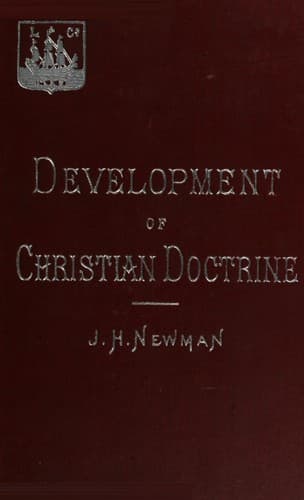
An Essay on the Development of Christian DoctrineNewman, John Henry
Religion
An Essay on the Development of Christian Doctrine
Newman, John Henry
Catholic Church -- Doctrines; Dogma, Development of
Now how are the modern sects, which protest against infant baptism, to
be answered by Anglicans with this array of great names in their favour?
By the later rule of the Church surely; by the _dicta_ of some later
Saints, as by St. Chrysostom; by one or two inferences from Scripture;
by an argument founded on the absolute necessity of Baptism for
salvation,--sufficient reasons certainly, but impotent to reverse the
fact that neither in Dalmatia nor in Cappadocia, neither in Rome, nor in
Africa, was it then imperative on Christian parents, as it is now, to
give baptism to their young children. It was on retrospect and after the
truths of the Creed had sunk into the Christian mind, that the authority
of such men as St. Cyprian, St. Chrysostom, and St. Augustine brought
round the _orbis terrarum_ to the conclusion, which the infallible
Church confirmed, that observance of the rite was the rule, and the
non-observance the exception.
8.
(4.) _Communion in one kind._
In the beginning of the fifteenth century, the Council of Constance
pronounced that, "though in the primitive Church the Sacrament" of the
Eucharist "was received by the faithful under each kind, yet the custom
has been reasonably introduced, for the avoiding of certain dangers and
scandals, that it should be received by the consecrators under each
kind, and by the laity only under the kind of Bread; since it is most
firmly to be believed, and in no wise doubted, that the whole Body and
Blood of Christ is truly contained as well under the kind of Bread as
under the kind of Wine."
Now the question is, whether the doctrine here laid down, and carried
into effect in the usage here sanctioned, was entertained by the early
Church, and may be considered a just development of its principles and
practices. I answer that, starting with the presumption that the Council
has ecclesiastical authority, which is the point here to be assumed, we
shall find quite enough for its defence, and shall be satisfied to
decide in the affirmative; we shall readily come to the conclusion that
Communion under either kind is lawful, each kind conveying the full gift
of the Sacrament.
For instance, Scripture affords us two instances of what may reasonably
be considered the administration of the form of Bread without that of
Wine; viz. our Lord's own example towards the two disciples at Emmaus,
and St. Paul's action at sea during the tempest. Moreover, St. Luke
speaks of the first Christians as continuing in the "_breaking of
bread_, and in prayer," and of the first day of the week "when they came
together to _break bread_."
Public-domain text, read in full here on John Shaqi.
Reviews
Reviews
No reviews yet
Be the first to share your thoughts on this work.
Elsewhere in the archive
Join the Discussion
Join the discussion
Sign in to leave a comment or review.
Sign InorCreate an account