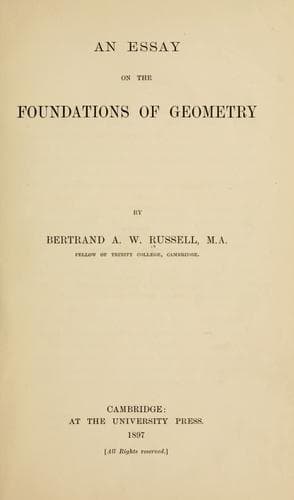
An essay on the foundations of geometryRussell, Bertrand
Philosophy
An essay on the foundations of geometry
Russell, Bertrand
Geometry -- Foundations
Given any three points _A_, _B_, _D_ in one straight line, the
quadrilateral construction finds the point _C_ harmonic to _A_ with
respect to _B_, _D_ by the following method: Take any point _O_
outside the straight line _ABD_, and join it to _B_ and _D_. Through
_A_ draw any straight line cutting _OD_, _OB_ in _P_ and _Q_. Join
_DQ_, _BP_, and let them intersect in _R_. Join _OR_, and let _OR_
meet _ABD_ in _C_. Then _C_ is the point required.
To prove this, let _DRQ_ meet _OA_ in _T_, and draw _AR_, meeting
_OD_ in _S_. Then a projective transformation of _A_, _B_, _C_, _D_
from _R_ on to _OD_ gives the points _S_, _P_, _O_, _D_, which,
projected from _A_ on to _DQ_, give _R_, _Q_, _T_, _D_. But these
again, projected from _O_ on to _ABD_, give _C_, _B_, _A_, _D_.
Hence _A_, _B_, _C_, _D_ can be projectively transformed into _C_,
_B_, _A_, _D_, and therefore form a harmonic range. From this point,
the proof that the construction is unique and general follows
simply[125].
The introduction of numbers, by this construction, offers no
difficulties of principle--except, indeed, those which always
attend the application of number to continua--and may be studied
satisfactorily in Klein's Nicht-Euklid (I. p. 337 ff.). The principle
of it is, to assign the numbers 0, 1, ∞ to _A_, _B_, _D_ and
therefore the number 2 to _C_, in order that the differences _AB_,
_AC_, _AD_ may be in harmonic progression. By taking _B_, _C_, _D_ as
a new triad corresponding to _A_, _B_, _D_, we find a point harmonic
to _B_ with respect to _C_, _D_ and assign to it the number 3, and so
on. In this way, we can obtain any number of points, and we are sure
of having no number and no point twice over, so that our coordinates
have the essential property of a unique correspondence with the
points they denote, and _vice versa_.
=114.= The point of importance in the above construction,
however, and the reason why I have reproduced it in detail, is
that it proceeds entirely by means of the general principles of
transformation enunciated above. From this stage onwards, everything
is effected by means of the two fundamental ideas we have just
discussed, and everything, therefore, depends on our general
principle of projective equivalence. This principle, as regards two
dimensions, may be stated more simply than in the passage quoted from
Cremona. It starts, in two dimensions, from the following definitions:
To project the points _A_, _B_, _C_, _D_ ... from a centre _O_, is to
construct the straight lines _OA_, _OB_, _OC_, _OD_....
To cut a number of straight lines _a_, _b_, _c_, _d_ ... by a
transversal _s_, is to construct the points _sa_, _sb_, _sc_,
_sd_....[126]
Public-domain text, read in full here on John Shaqi.
Reviews
Reviews
No reviews yet
Be the first to share your thoughts on this work.
Elsewhere in the archive
Join the Discussion
Join the discussion
Sign in to leave a comment or review.
Sign InorCreate an account