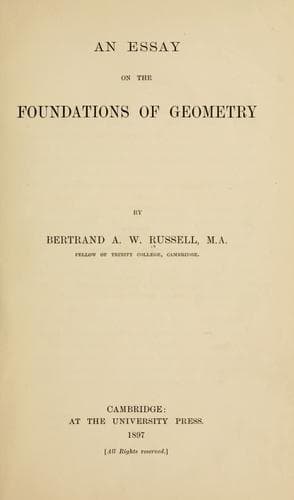
An essay on the foundations of geometryRussell, Bertrand
Philosophy
An essay on the foundations of geometry
Russell, Bertrand
Geometry -- Foundations
=204.= But can we agree in regarding empty space, the "infinite
given whole," as really given? Must we not, in spite of Kant's
argument, regard it as wholly conceptual? It is not required, in
the first place, by the argument of the first half of this chapter,
which required only that every _This_ of sense-perception should
be resolvable into _Thises_, and thus involved only an order among
_Thises_, not anything given originally without reference to them
at all. In the second place, Kant's two arguments[198] designed to
prove that empty space is not conceptual, are inadequate to their
purpose. The argument that the parts of space are not contained
_under_ it, but _in_ it, proves certainly that space is not a general
conception, of which spatial figures are the instances; but it by
no means follows that empty space is not a conception. Empty space
is undifferentiated and homogeneous; parts of space, or spatial
figures, arise only by reference to some differentiating matter, and
thus belong rather to spatial order than to empty space. If empty
space be the pre-condition of spatial order, we cannot expect it
to be connected with spatial relations as genus with species. But
empty space may nevertheless be a universal conception; it may be
related to spatial order as the state to the citizens. These are not
instances of the state, but are contained in it; they also, in a
sense, presuppose it, for a man can only become a citizen by being
related to other citizens in a state[199].
The uniqueness of space, again, seems hardly a valid argument for
its intuitional nature; to regard it as an argument implies, indeed,
that all conceptions are abstracted from a series of instances--a
view which has been criticized in Chapter II. (§ 77), and need not be
further discussed here[200]. There is no ground, therefore, in Kant's
two arguments for the intuitional nature of empty space, which can be
maintained against criticism.
=205.= Another ground for condemning empty space is to be found in
the mathematical antinomies. For it is no solution, as Lotze points
out (Metaphysik, Bk. II. Chap. I., § 106), to regard empty space as
purely subjective: contradictions in a necessary subjective intuition
form as great a difficulty as in anything else. But these antinomies
arise only in connection with empty space, not with spatial order
as an aggregate of relations. For only when space is regarded as
possessed of some thinghood, can a whole or a true element be
demanded. This we have seen already in connection with the Point.
When space is regarded, so far as it is valid, as only spatial order,
unbounded extension and infinite divisibility both disappear. What
is divided is not spatial relations, but matter; and if matter, as
we have seen that Geometry requires, consists of unextended atoms
with spatial relations, there is no reason to regard matter either as
infinitely divisible, or as consisting of atoms of finite extension.
Public-domain text, read in full here on John Shaqi.
Reviews
Reviews
No reviews yet
Be the first to share your thoughts on this work.
Elsewhere in the archive
Join the Discussion
Join the discussion
Sign in to leave a comment or review.
Sign InorCreate an account