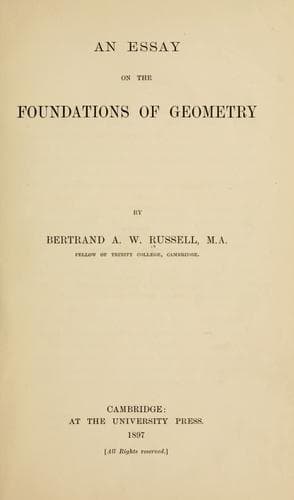
An essay on the foundations of geometry — John Shaqi
An essay on the foundations of geometryRussell, Bertrand
Philosophy
An essay on the foundations of geometry
Russell, Bertrand
Geometry -- Foundations
The above statement of the three essential axioms of metrical
Geometry is taken from Helmholtz as amended by Lie. Lie's own
statement of the axioms, as quoted above, has been too much
influenced by projective methods to give a historically correct
rendering of the spirit of the second period; Helmholtz's statement,
on the other hand, requires, as Lie has shewn, very considerable
modifications. The above compromise may, therefore, I hope be taken
as accepting Lie's corrections while retaining Helmholtz's spirit.
=48.= But metrical Geometry, though it is historically prior, is
logically subsequent to projective Geometry. For projective Geometry
deals directly with that qualitative likeness, which the judgment of
quantitative comparison requires as its basis. Now the above three
axioms of metrical Geometry, as we shall see in Chapter III. Section
B, do not presuppose measurement, but are, on the contrary, the
conditions presupposed by measurement. Without these axioms, which
are common to all three spaces, measurement would be impossible;
with them, so I shall contend, measurement is able, though only
empirically, to decide approximately which of the three spaces is
valid of our actual world. But if these three axioms themselves
express, not results, but conditions, of measurement, must they not
be equivalent to the statement of that qualitative likeness on which
quantitative comparison depends? And if so, must we not expect to
find the same axioms, though perhaps under a different form, in
projective Geometry?
=49.= This expectation will not be disappointed. The above three
axioms, as we shall see hereafter, are one and all philosophically
equivalent to the homogeneity of space, and this in turn is
equivalent to the axioms of projective Geometry. The axioms of
projective Geometry, in fact, may be roughly stated thus:
I. Space is continuous and infinitely divisible; the zero of
extension, resulting from infinite division, is called a Point. All
points are qualitatively similar, and distinguished by the mere fact
that they lie outside one another.
II. Any two points determine a unique figure, the straight line;
two straight lines, like two points, are qualitatively similar, and
distinguished by the mere fact that they are mutually external.
III. Three points not in one straight line determine a unique figure,
the plane, and four points not in one plane determine a figure of
three dimensions. This process may, so far as can be seen _à priori_,
be continued, without in any way interfering with the possibility
of projective Geometry, to five or to _n_ points. But projective
Geometry requires, as an axiom, that the process should stop with
some positive integral number of points, after which, any fresh point
is contained in the figure determined by those already given. If the
process stops with (_n_ + 1) points, our space is said to have _n_
dimensions.
Public-domain text, read in full here on John Shaqi.
Reviews
Reviews
No reviews yet
Be the first to share your thoughts on this work.
Join the Discussion
Join the discussion
Sign in to leave a comment or review.
Sign InorCreate an account