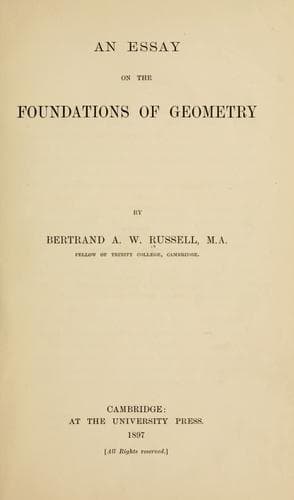
An essay on the foundations of geometryRussell, Bertrand
Philosophy
An essay on the foundations of geometry
Russell, Bertrand
Geometry -- Foundations
But Kant's doctrine, if true, is designed to restrain a critical
scepticism even where it might be effective. Certain fundamental
propositions, he says, are not deducible from logic, _i.e._
their contradictories are not self-contradictory; they combine a
subject and predicate which cannot, in any purely logical way,
be shewn to have any connection, and yet these judgments have
apodeictic certainty. But concerning such judgments, Kant is
generally careful not to rely upon the mere subjective conviction
that they are undeniable: he proves, with every precaution, that
without them experience would be impossible. Experience consists
in the combination of terms which formal logic leaves apart, and
presupposes, therefore, certain judgments by which a framework is
made for bringing such terms together. Without these judgments--so
Kant contends--all synthesis and all experience would be impossible.
If, therefore, the detail of the Kantian reasoning be sound, his
results may be obtained by the principle of contradiction _plus_ the
possibility of experience, as well as by his distinction of synthetic
and analytic judgments.
Logic, at the present day, arrogates to itself at once a wider and a
narrower sphere than Kant allowed to it. Wider, because it believes
itself capable of condemning any false principle or postulate;
narrower, because it believes that its law of contradiction,
without a given whole or a given hypothesis, is powerless, and
that two terms, _per se_, though they may be different, cannot be
contradictories, but acquire this relation only by combination
in a whole about which something is known, or by connection with
a postulate which, for some reason, must be preserved. Thus no
judgment, _per se_, is either analytic or synthetic, for the
severance of a judgment from its context robs it of its vitality, and
makes it not truly a judgment at all. But in its proper context it
is neither purely synthetic nor purely analytic; for while it is the
further determination of a given whole, and thus in so far analytic,
it also involves the emergence of _new_ relations within this whole,
and is so far synthetic.
Public-domain text, read in full here on John Shaqi.
Reviews
Reviews
No reviews yet
Be the first to share your thoughts on this work.
Elsewhere in the archive
Join the Discussion
Join the discussion
Sign in to leave a comment or review.
Sign InorCreate an account