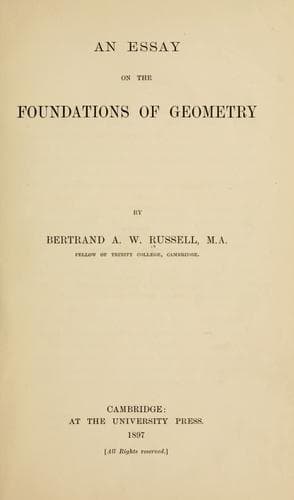
An essay on the foundations of geometryRussell, Bertrand
Philosophy
An essay on the foundations of geometry
Russell, Bertrand
Geometry -- Foundations
of space may be left wholly out of account during the course of this
discussion, which will gain by dealing exclusively with logical, as
opposed to psychological points of view.
=56.= (1) _Kant's logical position._ The doctrine of synthetic and
analytic judgments--at any rate if this is taken as the corner-stone
of Epistemology--has been so completely rejected by most modern
logicians[71], that it would demand little attention here, but
for the fact that an enthusiastic French Kantian, M. Renouvier,
has recently appealed to it, with perfect confidence, on the very
question of Geometry[72]. And it must be owned, with M. Renouvier,
that if such judgments existed, in the Kantian sense, non-Euclidean
Geometry, which makes no appeal to intuition, could have nothing to
say against them. M. Renouvier's contention, therefore, forces us
briefly to review the arguments against Kant's doctrine, and briefly
to discuss what logical canon is to replace it.
Every judgment--so modern logic contends--is both synthetic and
analytic; it combines parts into a whole, and analyses a whole into
parts[73]. If this be so, the distinction of analysis and synthesis,
whatever may be its importance in pure Logic, can have no value in
Epistemology. But such a doctrine, it must be observed, allows full
scope to the principle of contradiction: this criterion, since all
judgments, in one aspect at least, are analytic, is applicable to
all judgments alike. On the other hand, the whole which is analysed
must be supposed already given, before the parts can be mutually
contradictory: for only by connection in a given whole can two parts
or adjectives be incompatible. Thus the principle of contradiction
remains barren until we already have some judgments, and even some
inference: for the parts may be regarded, to some extent, as an
inference from the whole, or _vice versâ_. When once the arch of
knowledge is constructed, the parts support one another, and the
principle of contradiction is the keystone: but until the arch is
built, the keystone remains suspended, unsupported and unsupporting,
in the empty air. In other words, knowledge once existent can be
analysed, but knowledge which should have to win every inch of the
way against a critical scepticism, could never begin, and could never
attain that circular condition in which alone it can stand.
Public-domain text, read in full here on John Shaqi.
Reviews
Reviews
No reviews yet
Be the first to share your thoughts on this work.
Elsewhere in the archive
Join the Discussion
Join the discussion
Sign in to leave a comment or review.
Sign InorCreate an account