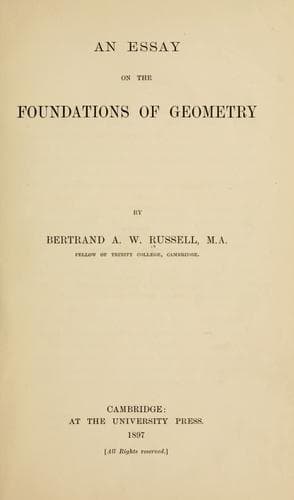
An essay on the foundations of geometryRussell, Bertrand
Philosophy
An essay on the foundations of geometry
Russell, Bertrand
Geometry -- Foundations
=58.= (2) _Kant's arguments for the apriority of space._ Having now
discussed the logical canon to be used as regards the _à priori_, we
may proceed to test Kant's arguments as regards space. The argument
from Geometry, as remarked above, is upset by Metageometry, at least
so far as those properties are concerned, which belong to Euclid
but not to non-Euclidean spaces; as regards the common properties
of both kinds of space, we cannot decide on their apriority till we
have discussed the consequences of denying them, which will be done
in Chapter III. As regards the two arguments which prove that space
is an intuition, not a concept, they would call for much discussion
in a special criticism of Kant, but here they may be passed by
with the obvious comment that infinite homogeneous Euclidean space
is a concept, not an intuition--a concept invented to explain an
intuition, it is true, but still a pure concept[74]. And it is this
pure concept which, in all discussions of Geometry, is primarily to
be dealt with; the intuition need only be referred to where it throws
light on the functions or the nature of the concept. The second
of Kant's arguments, that we can imagine empty space, though not
the absence of space, is false if it means a space without matter
anywhere, and irrelevant if it merely means a space between matters
and regarded as empty[75]. The only argument of importance, then,
is the first argument. But I must insist, at the outset, that our
problem is purely logical, and that all psychological implications
must be excluded to the utmost possible extent. Moreover, as will be
proved in Chapter IV., the proper function of space is to distinguish
between different presented things, not between the Self and the
object of sensation or perception. The argument then becomes the
following: consciousness of a world of mutually external things
demands, in presentations, a cognitive but non-inferential element
leading to the discrimination of the objects presented. This element
must be non-inferential, for from whatever number or combination of
presentations, which did not of themselves demand diversity in their
objects, I could never be led to infer the mutual externality of
their objects. Kant says: "In order that sensations may be ascribed
to something external to me ... and similarly in order that I may
be able to present them as outside and beside one another, ... the
presentation of space must be already present." But this goes rather
too far: in the first place, the question should be only as to the
mutual externality of presented things, not as to their externality
to the Self[76]; and in the second place, things will appear mutually
external if I have the presentation of _any_ form of externality,
whether Euclidean or non-Euclidean. Whatever may be true of the
_psychological_ scope of this argument--whose validity is here
irrelevant--the _logical_ scope extends, not to Euclidean space, but
Public-domain text, read in full here on John Shaqi.
Reviews
Reviews
No reviews yet
Be the first to share your thoughts on this work.
Elsewhere in the archive
Join the Discussion
Join the discussion
Sign in to leave a comment or review.
Sign InorCreate an account