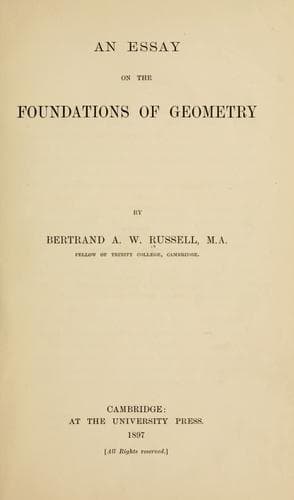
An essay on the foundations of geometryRussell, Bertrand
Philosophy
An essay on the foundations of geometry
Russell, Bertrand
Geometry -- Foundations
only to any form of externality which could exist intuitively, and
permit knowledge, in beings with our laws of thought, of a world of
diverse but interrelated things.
Moreover externality, to render the scope of the argument wholly
logical, must not be left with a sensational or intuitional meaning,
though it must be supposed given in sensation or intuition. It must
mean, in this argument, the fact of Otherness[77], the fact of being
different from some other thing: it must involve the distinction
between different things, and must be that element, in a cognitive
state, which leads us to discriminate constituent parts in its
object. So much, then, would appear to result from Kant's argument,
that experience of diverse but interrelated things demands, as a
necessary prerequisite, some sensational or intuitional element, in
perception, by which we are led to attribute complexity to objects
of perception[78]; that this element, in its isolation may be called
a form of externality; and that those properties of this form, if
any such be found, which can be deduced from its mere function of
rendering experience of interrelated diversity possible, are to
be regarded as _à priori_. What these properties are, and how the
various lines of argument here suggested converge to a single result,
we shall see in Chapters III. and IV.
=59.= In the philosophers who followed Kant, Metaphysics, for the
most part, so predominated over Epistemology, that little was added
to the theory of Geometry. What was added, came indirectly from
the one philosopher who stood out against the purely ontological
speculations of his time, namely _Herbart_. Herbart's actual views on
Geometry, which are to be found chiefly in the first section of his
_Synechologie_, are not of any great value, and have borne no great
fruit in the development of the subject. But his psychological theory
of space, his construction of extension out of series of points, his
comparison of space with the tone and colour-series, his general
preference for the discrete above the continuous, and finally his
belief in the great importance of classifying space with other forms
of series (_Reihenformen_[79]), gave rise to many of Riemann's
epoch-making speculations, and encouraged the attempt to explain the
nature of space by its analytical and quantitative aspect alone[80].
Through his influence on Riemann, he acquired, indirectly, a great
importance in geometrical philosophy. To Riemann's dissertation,
which we have already discussed in its mathematical aspect, we must
now return, considering, this time, only its philosophical views.
Riemann.
Public-domain text, read in full here on John Shaqi.
Reviews
Reviews
No reviews yet
Be the first to share your thoughts on this work.
Elsewhere in the archive
Join the Discussion
Join the discussion
Sign in to leave a comment or review.
Sign InorCreate an account