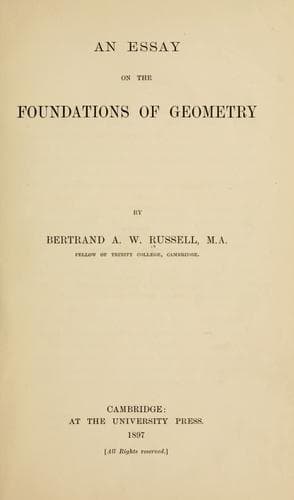
An essay on the foundations of geometryRussell, Bertrand
Philosophy
An essay on the foundations of geometry
Russell, Bertrand
Geometry -- Foundations
We cannot know, it is true, what _psychological_ theory
of space-perception would apply to such beings: they might have a
sense different from any of ours, and they might have no sense in
any way resembling ours, but yet their Geometry would have points of
resemblance to ours, as that of the blind coincides with that of the
seeing. If space has any objective counterpart whatever, in short,
and if any inference is possible, as Lotze holds it to be, from space
to its counterpart, then a converse argument is also possible, though
it may give some only of the qualities of Euclidean space, since some
only of these qualities may be found to have a necessary analogue in
the counterpart.
=87.= Admitting, then, in Lotze's sense, the subjectivity of space,
the above possibility does not seem so empty as he imagines. He
discusses it briefly, however, in order to pass on to what he regards
as the real meaning of Metageometry. In this he is guilty of a
mathematical mistake, which causes much irrelevant reasoning. For
he believes that Metageometry constructs its spaces out of straight
lines and angles in all respects similar to Euclid's, whence he
derives an easy victory in proving that these elements can lead only
to the one space. In this he has been misled by the phraseology of
non-Euclideans, as well as by Euclid's separation of definitions
and axioms. For the fact is, of course, that straight lines are
only fully defined when we add to the formal definition the axioms
of the straight line and of parallels. Within Euclidean space,
Euclid's definition suffices to distinguish the straight line from
all other curves; the two axioms referred to are then absorbed into
the definition of space. But apart from the restriction to Euclidean
space, the definition has to be supplemented by the two axioms, in
order to define completely the Euclidean straight line. Thus Lotze
has misconceived the bearing of non-Euclidean constructions, and
has simply missed the point in arguing as he does. The possibility
contemplated by a non-Euclidean, if it fell under any of Lotze's
cases, would fall under the second case discussed above.
=88.= But the bearing of Metageometry is really, I think, different
from anything imagined by Lotze; and as few writers seem clear on
this point, I will enter somewhat fully into what I conceive to be
its purpose.
In the first place, there are some writers--notably Clifford--who,
being naïve realists as regards space, hold that our evidence is
wholly insufficient, as yet, to decide as to its nature in the
infinite or in the infinitesimal (cf. Essays, Vol. I. p. 320):
these writers are not concerned with any possibility of beings
different from ourselves, but simply with the everyday space we
know, which they investigate in the spirit of a chemist discussing
whether hydrogen is a metal, or an astronomer discussing the nebular
hypothesis.
Public-domain text, read in full here on John Shaqi.
Reviews
Reviews
No reviews yet
Be the first to share your thoughts on this work.
Elsewhere in the archive
Join the Discussion
Join the discussion
Sign in to leave a comment or review.
Sign InorCreate an account