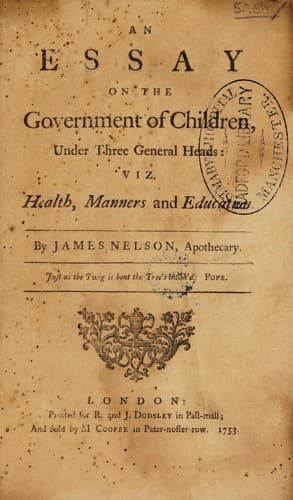
An essay on the government of children, under three general heads, viz. health, manners, and educationNelson, James
History
An essay on the government of children, under three general heads, viz. health, manners, and education
Nelson, James
Child rearing -- England -- History -- 18th century
the greatest Proof they can give of their Courage is to run away, because
their Passions naturally incline them to stay; that those, in a word,
who wish to maintain their Virtue, must shun the Vicious: and where the
Affairs of Life unavoidably expose them to the Company of such, let them
by a constant discountenancing Deportment, shew their Disapprobation
of every unbecoming Word or Action; whereby they will check, and often
prevent, any Attacks on their Innocence. But farther, to enforce the
Virtue of Innocence, let Parents shew their Children the Obligations they
are under of preserving it; that besides the Insult offered to their
Creator who made them rational Beings, and thereby distinguished them
from the Brutes, their departing from it is an Injustice to themselves,
an Injustice to their Parents, and to all those who have laboured to
correct the natural Corruption of their Hearts, by instilling into them
every virtuous Principle.
A fourth Cause of Injustice is Avarice: which implies an inordinate Love
of Gain. Avarice puts on a thousand Shapes, and is to be found in Men
of every Rank and every Age; but it is most apparent in the Rich and
the Old: which is an Aggravation of the Vice; because the one have more
than enough already, and the other have not long to enjoy the Fruits
of it, even should they live to reap them. But what is most alarming
in the Avaritious is, the extreme Danger of going beyond the Bounds
of Justice; and what _Dryden_[5] says of Wits and Madmen may, by the
easiest Change,[6] be apply’d without Impropriety to the Covetous and the
Dishonest. How many Schemes are formed, how many Devices used to raise a
Fortune, or to add Hoard to Hoard? One circumvents another in Trade; and
with more than savage Cruelty, abuses the Power he has by keeping those
under that might otherwise flourish; and had rather see another starve,
than himself be deprived of what he does not want. A second burns with
a Thirst of Gaming, and values himself for his superior Parts, if he
can trick another out of his Money at Play; regardless of the dreadful
Consequences attending the Loss; and regardless of the Injustice of
the Acquisition. How do they possess their Minds who have raised their
Fortune on another’s Ruin? Do they ever reflect on the Misery of their
wretched Companion; or do they view the Distress of his Wife, his
Children, and his suffering Creditors? Surely if the Gamester did this,
even he who wins, and wins by a fair Bet, and equal Lay, must tremble at
Riches thus acquired: but if to this be added the Traps, the Snares, and
other Artifices to draw in weak or unwary Men to their Ruin, what must we
think of such Wretches? We may both pity and condemn the Ruined, but we
must abhor those who caused it, however great their false Triumph may be.
A third takes the Advantage of Distress or Weakness, and lends his Money,
not with Kindness, but with a sordid View: these are the Men who grasp at
Public-domain text, read in full here on John Shaqi.
Reviews
Reviews
No reviews yet
Be the first to share your thoughts on this work.
Elsewhere in the archive
Join the Discussion
Join the discussion
Sign in to leave a comment or review.
Sign InorCreate an account