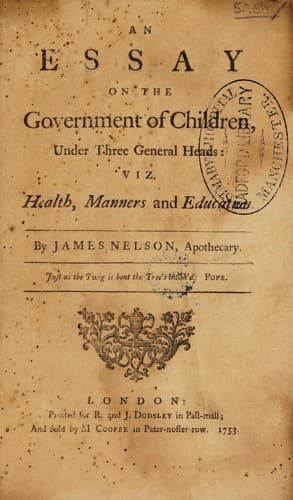
An essay on the government of children, under three general heads, viz. health, manners, and educationNelson, James
History
An essay on the government of children, under three general heads, viz. health, manners, and education
Nelson, James
Child rearing -- England -- History -- 18th century
But here I must observe, that many things are looked upon as grievous
Evils, which, if considered in a proper Light, are no Evils at all:
and to what is this owing? certainly to the erroneous Measures taken
at setting out. The Eagerness of Children after every new Trifle, the
Desire of engaging in whatever is called Pleasure, and the early Passion
for Dress and Show, make them earnest to have their Humour comply’d
with. Now as many of these things are highly improper, gratifying
their Demands must be an Error more or less; but this is the least
Part of the Evil: the Habit of having all they desire increases with
their Years; and without considering, whether the Things they seek are
necessary or reasonable, they pursue their Desires, and are wretched when
disappointed. Hence arise many of the Passions which disturb the Oeconomy
of Families, and fill the World with Disorder: Men disappointed in
their Business, and cross’d in their Will, burst into Rage, or contract
a Fretfulness which makes them unhappy in themselves, and painful to
all who see or feel the Effects of it: and Women who have been used in
Childhood to conquer their Parents, and in Youth all the World, who have
been constantly addressed in the language of Romances, and have been
vainly taught to think the Men their Slaves; Women, I say, who are thus
educated, are but very ill prepared to meet Disappointments: the first
Opposition throws them into Fits, whence follow Vapours, Melancholy
and Indolence; the next kindles their Resentment, which agitates the
Mind, spoils the Features, by tearing off the natural Softness of the
Countenance, and puts the sweetest Temper into a Ferment; and, if a
Husband be the Object of it, ’tis great Odds but a short Time creates
either an unjust Coldness, or a fixed Aversion. Mr. _Locke_, sensible
of the Danger of irregular Indulgence, thus describes the Situation of a
fondled Son. “He that hath been used to have his Will in every thing as
long as he was in Coats, why should we think it strange that he should
desire it, and contend for it still, when he is in Breeches? Indeed, as
he grows towards a Man, Age shews his Faults the more; so that there are
few Parents then so blind as not to see them, few so insensible as not to
feel the ill Effects of their own Indulgence. He had the Will of his Maid
before he could speak or go; he had the Mastery of his Parents ever since
he could prattle; and why, now he is grown up, is stronger and wiser than
he was then, why now of a sudden should he be restrained and curbed? Why
must he at seven, fourteen, or twenty Years old, lose the Privilege,
which his Parents Indulgence till then so largely allowed him?” From all
this it is evident, that the early planting of regular Desires, checking
the Growth of vicious ones, and subjecting Passion to Reason, are the
great Means to lay the Foundation of Happiness in our Children, and the
surest Fence against many Evils they would otherwise be exposed to: but
Public-domain text, read in full here on John Shaqi.
Reviews
Reviews
No reviews yet
Be the first to share your thoughts on this work.
Elsewhere in the archive
Join the Discussion
Join the discussion
Sign in to leave a comment or review.
Sign InorCreate an account