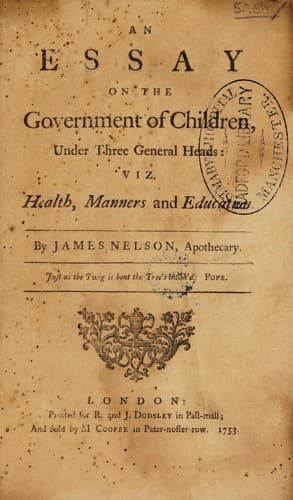
An essay on the government of children, under three general heads, viz. health, manners, and educationNelson, James
History
An essay on the government of children, under three general heads, viz. health, manners, and education
Nelson, James
Child rearing -- England -- History -- 18th century
being conspicuously dress’d, of sauntering and dangling one part of his
Time away, and raking and gaming another part; if we see too, that his
only Fear, is the Fear of having occasion to fight; we should certainly
reject his Request, and oblige him to apply another way: nay more, we
should convince him how mean a Soul he must have, to seek so inglorious
a life. In like manner, if we see a Boy whose Head is manifestly turned
for Business, whose Cast of Temper argues Method in every Action, we may
pretty safely conclude we hit his Genius, by making him a Merchant. But
there is a capital Mistake Parents frequently commit, that is, their
being influenced by some oblique Interest; which often tends to ruin
their Children. For Example: the Family has a Living in their Gift, and
a Boy must be bred a Clergyman on purpose to fill it: or there is an
Uncle a Bishop, therefore the Nephew must be a Bishop too; tho’ perhaps
he has no more Genius nor Chance for it, than he has of being Emperor of
_Morocco_. Thus another, who would have been an Adept in the Mathematics,
and have done Honour to the Science, or whose Sprightliness would have
made a Figure in polite Literature, is cramp’d with the Study of the Law;
not because he likes it, but because it is a Profession that may raise
him to be a Judge; perhaps Lord Chancellor: tho’ he has as little Chance
for either as the Clerk to a Justice of Peace. A third, in Nature’s
spite, is made a Physician, only because his Parents have seen a _Mead_,
a _Hulse_, or a _Wilmot_ standing at the Top of the Profession; and
therefore conclude their Son will have equal Genius and equal Merit.
Here then it is evident, that Parents are often mistaken, not only by
Inattention to the Genius of their Children, but by overrating their
Parts; by fixing a Profession for them, perhaps as soon as they are
born, or by blundering them into an Employment which their Education is
not equal to. On this last Point let me explain myself. Suppose I have
not over-rated a Boy’s natural Parts; suppose too that I have at great
Expence kept him at School for ten Years; it does not from hence follow
that he is learned: I must know if he has applied and improved these
Years to his real Advantage; that is, whether his Learning is deep or
superficial; I must know too the Tenor of his Studies, for even of those
who are very diligent, all Parts of Learning are not equal Favourites;
some are sprightly, some grave, some in short more striking to them than
others: lastly, I must know if the Nature of his Education be adapted to
the Employment I am about to engage him in. Without Attention and Regard
to these Circumstances, it will be impossible to keep clear of Error in
the Disposal of our Children for Life: and as not only themselves, but
Society too, must feel the good or bad Effects of our Choice, it is of
the highest Consequence that it be judicious.
Public-domain text, read in full here on John Shaqi.
Reviews
Reviews
No reviews yet
Be the first to share your thoughts on this work.
Elsewhere in the archive
Join the Discussion
Join the discussion
Sign in to leave a comment or review.
Sign InorCreate an account