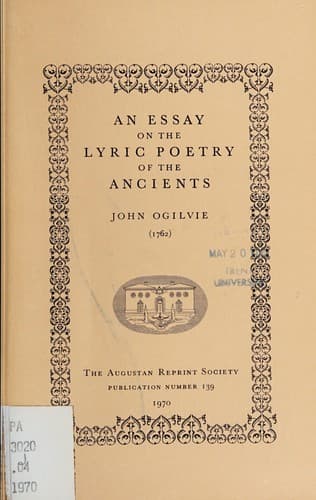
An Essay on the Lyric Poetry of the Ancients — John Shaqi
An Essay on the Lyric Poetry of the AncientsOgilvie, John
History
An Essay on the Lyric Poetry of the Ancients
Ogilvie, John
Classical poetry -- History and criticism
[Footnote 77: Thus the reader, who would pay little regard to the
person who should forbid him to trust the world too much, will yet
be struck with this simple admonition, when it appears in the work
of a genius.
Lean not on earth, ’twill pierce thee to the heart;
A broken reed at best, but oft’ a spear,
On its sharp point Peace bleeds, and Hope expires.
NIGHT THOUGHTS.]
[Footnote 78: Thus Xenophon, the simplest and most perspicuous of
Historians, has borrowed many noble images from Homer; and Plato
is often indebted to this Poet, whom yet he banished from his
Commonwealth. Cicero in his most serious pieces studies the
_diction_, and copies the _manner_ of the Greek Philosopher; and
it evidently appears, that Thucydides has taken many a _glowing
Metaphor_ from the Odes of Pindar. We might produce many examples
of this from their writings, if these would not swell this note to
too great a length. The reader of taste may see this subject fully
discussed in Mr. Gedde’s ingenious Essay on the Composition of the
Ancients.]
[Footnote 79: Δει δε τους μυθους συνισταναι, και τη λεξει
συναπεργαζεσθαι οντι μαλιστα προς ομματων τεθεμενον. Οὑτο γαρ αν’
εναργεστατα ὁρων ὡσπερ παρ αυτοις γιγνομενος τοις πραττομενοις,
εὑρισκοι το πρεπον, και ἡκιστα αν’ λανθανοιτο τα ὑπεναντια.
Arist. Poet. c. 17.]
[Footnote 80: Thus Cicero tells us. Nec est majus in dicendo, quam
ut Orator sic moveatur, ut impetu quodam animi, & perturbatione
magis quam concilio regatur. Plura enim multo homines judicant
odio, & amore, & cupiditate, &c. quam veritate & præscripto.
De Orat. Lib. II. c. 42.]
It is obvious, that in Lyric Poetry the Author cannot run into this
series of methodised allegory, because the subjects of the Ode are real
incidents which would be disfigured by the continued action of
fictitious personages. His descriptions therefore ought to be concise,
diversified, and adapted properly to that train of sentiment which he is
employed to illustrate. When this is the case, we are highly entertained
with frequent personifications, as these are criterions by which we
estimate the genius of the Poet.
Public-domain text, read in full here on John Shaqi.
Reviews
Reviews
No reviews yet
Be the first to share your thoughts on this work.
Join the Discussion
Join the discussion
Sign in to leave a comment or review.
Sign InorCreate an account