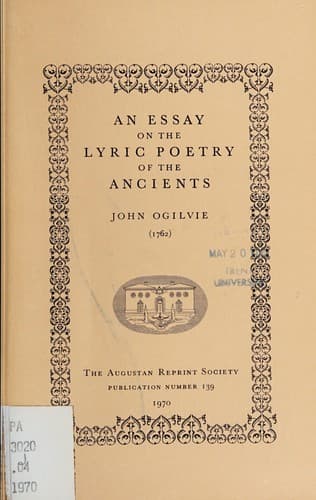
An Essay on the Lyric Poetry of the AncientsOgilvie, John
History
An Essay on the Lyric Poetry of the Ancients
Ogilvie, John
Classical poetry -- History and criticism
I need not, my Lord, to suggest on this branch of my subject, that it
requires the utmost delicacy to personify inanimate objects so justly,
as to render them adapted in every circumstance to the occasion on which
they are introduced. Your Lordship however will permit me to observe,
that as the happiest effect is produced upon the mind of the reader by
the judicious introduction of an ideal personage; so he is apt to be
disgusted in an equal degree, when the conduct of the Poet in this
instance is in the smallest measure irregular or defective. When an
intellectual idea falls under the cognizance of an external sense, it is
immediately surveyed with an accuracy proportioned to its importance,
and to the distance at which we suppose it to be placed. We judge of
Virtue and Vice, when represented as persons, in the same manner as we
judge of men whose appearance is suggested by memory; and we therefore
expect that these ideal figures shall be discriminated from each other
by their dress, attitudes, features, and behaviour, as much as two real
persons of opposite characters always are in the familiar intercourse of
ordinary life. In reality we assign a particular shape, complection, and
manner to the creatures of imagination, by the same rule which leads us
to ascribe a certain assemblage of features to a person whom we have
never seen, upon seeing his character particularly displayed, or upon
listening to a minute detail of his actions. Nay, odd as it may appear,
it is yet certain, that in many instances our idea of the imaginary
person may be more distinct and particular than that of the real one.
Thus we often find that the representation exhibited by Fancy of the
figure of an Heroe, whose actions had raised admiration; I say, we find
that this representation has been wide of the truth, when we come either
to see the original, or a faithful copy of it: but our ideas of
imaginary persons are generally so exact, that upon seeing a group of
these displayed on a plate, we are capable to give each its proper
designation, as soon as we observe it. Thus Anger, Revenge, Despair,
Hope, &c. can be distinguished from each other almost as easily when
they are copied by the pencil, as when _we feel their influence on our
own minds, or make others observe it on our actions_.
Public-domain text, read in full here on John Shaqi.
Reviews
Reviews
No reviews yet
Be the first to share your thoughts on this work.
Join the Discussion
Join the discussion
Sign in to leave a comment or review.
Sign InorCreate an account