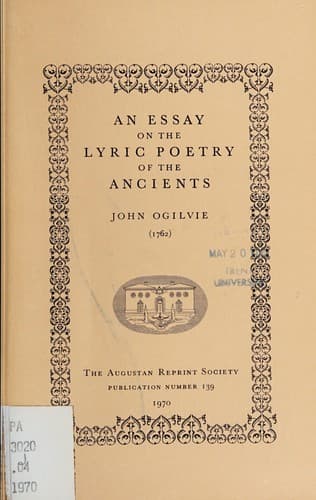
An Essay on the Lyric Poetry of the AncientsOgilvie, John
History
An Essay on the Lyric Poetry of the Ancients
Ogilvie, John
Classical poetry -- History and criticism
The same principle which induceth us to approve of Poet’s transitions in
the preceding instances, must (as your Lordship will immediately
conceive) lead us to condemn those which are far-fetched, pursued too
closely, or foreign to the subject of the poem. This is frequently the
consequence of following the track of imagination with implicit
compliance, as the Poet without being sensible of his mistake runs into
one digression after another, until his work is made up of incoherent
ideas; in which, as Horace expresseth it,
velut ægri somnia vanæ
Finguntur species, ut nec pes, nec caput uni
Reddatur formæ[75].
This is the character of the Ode to Thrasidæus the Theban, in which the
Poet is insensibly led from one digression to another, until his readers
lose sight of the principal subject which is dropped almost as soon as
proposed[76].
[Footnote 75: Hor. de Art. Poet.]
[Footnote 76: Pind. Pyth. Ode XI.]
The last circumstance mentioned as characteristic of the Ode, was a
certain picturesque vivacity of description. In this we permit the Lyric
Poet to indulge himself with greater freedom than any other, because
beauties of this kind are necessary to the end of exciting admiration.
It is the peculiar province of imagination to give that life and
expression to the ideas of the mind, by which Nature is most happily and
judiciously imitated. By the help of this poetical magic the coldest
sentiments become interesting, and the most common occurrences arrest
our attention. A man of Genius, instead of laying down a series of dry
precepts for the conduct of life, exhibits his sentiments in the most
animating manner, by moulding them into symmetry, and superadding the
external beauties of drapery and colour[77]. His reader by this
expedient is led through an Elysium, in which his Fancy is alternately
soothed and transported with a delightful succession of the most
agreeable objects, whose combination at last suggests an important moral
to be impressed upon the memory. The Ancients appear to have been fully
sensible of the advantages of this method of illustrating truth, as the
works not only of their Poets, but even those of their Philosophers and
Historians abound with just and beautiful personifications[78]. Their
two allegorical Philosophers, Prodicus and Cebes, carry the matter still
further, and inculcate their lessons, by substituting in place of cool
admonition a variety of personages, who assume the most dignified
character, and address at the same time the imagination, the passions,
and even the senses of mankind[79]. These Authors consider man as a
creature possessed of different, and of limited faculties, whose actions
are directed more frequently by the impulse of passion, than regulated
by the dictates of reason and of truth[80].
Public-domain text, read in full here on John Shaqi.
Reviews
Reviews
No reviews yet
Be the first to share your thoughts on this work.
Join the Discussion
Join the discussion
Sign in to leave a comment or review.
Sign InorCreate an account