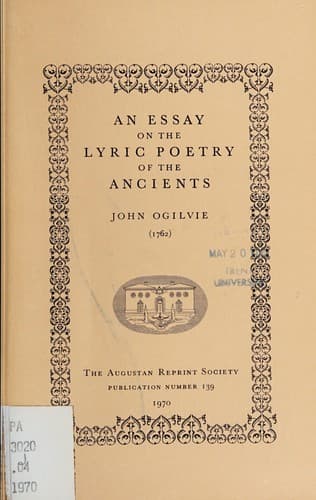
An Essay on the Lyric Poetry of the AncientsOgilvie, John
History
An Essay on the Lyric Poetry of the Ancients
Ogilvie, John
Classical poetry -- History and criticism
From this detail it obviously follows, that as our ideas of imaginary
personages are more just and accurate, than those which are excited
merely by a particular relation of the actions of real ones; so we will
judge with more certainty of the precise colouring which belongs to the
former, and of the propriety with which they are introduced, than we can
possibly do with regard to the latter. A Painter may deceive us, by
throwing into the face of an Heroe, whom we have never seen, particular
marks of resolution and fortitude, which form only a part of his
character. But we cannot be deceived with regard to the signatures which
show the predominancy of these virtues, with whatever degree of justice
they may be applied. This observation has equal force, when we refer it
to the allegorical personages of the Poet. The least impropriety in the
colouring, dress, or arrangement of objects, is immediately perceptible,
and we pass a favourable judgment, when faults of this kind are ascribed
to inattention. In short, the imaginary persons who are introduced in a
poem, must on all occasions be distinguished by peculiar characters, and
the manners attributed to each of them ought to be such as can be
applied with no propriety to any other object. Every picture must
therefore be, as Pope somewhere has it,
Something whose truth convinc’d at sight we find.
That gives us back the image of the mind.
A little reflection will enable us to discover the reason of this
difference betwixt our ideas of allegorical and of real personages.
We are (as I formerly observed) often mistaken in our notions of the
latter of these, because the mind cannot receive a sufficient degree
of information, concerning the person, to be able to form any perfect
judgment of his address or demeanour. Upon hearing, for instance,
a recital of the actions of a man who is unknown to us, our idea of
him is taken from the passion which appears to have predominated in his
conduct; but we are not acquainted with numberless little peculiarities
which enter into a complicated character, and have their corresponding
expressions imprinted on the countenance. Thus when we consider only the
martial exploits of the celebrated Duke de Vendome, we have the idea of
an Heroe full of spirit and impetuosity; but this idea would be very
imperfect as a representation of his character, if we did not know
likewise that he was slovenly, voluptuous, effeminate, and profuse[81].
[Footnote 81: Volt. Siec. Louis XIV. c. 21.]
Public-domain text, read in full here on John Shaqi.
Reviews
Reviews
No reviews yet
Be the first to share your thoughts on this work.
Join the Discussion
Join the discussion
Sign in to leave a comment or review.
Sign InorCreate an account